



US-China agree on tariff stability amid rising tensions
Mar 17, 2026, 10:04 am


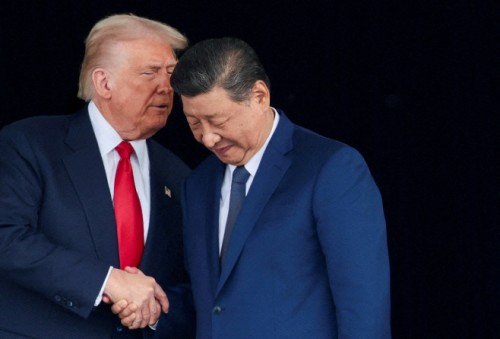 |
| U.S. President Donald Trump and Chinese President Xi Jinping talk after a summit at Gimhae International Airport on Oct. 30, 2025. / Reuters-Yonhap |
U.S. President Donald Trump signaled a possible delay of his planned visit to China later this month, citing tensions over the Strait of Hormuz and a potential conflict with Iran, even as Washington and Beijing reached a consensus on tariff stability during trade talks in Paris.
In an interview with the Financial Times, Trump urged China and U.S. allies to contribute naval forces to secure the strategic waterway, warning that failure to respond could have serious consequences for NATO.
“If countries benefiting from the strait do not help ensure nothing bad happens there, it will matter,” Trump said, adding that China—highly dependent on oil shipments through the route—should also take part. He suggested the visit to China could be postponed depending on Beijing’s cooperation.
The remarks cast what the New York Times described as a “new shadow” over relations between the world’s two largest economies.
Trump has also called on countries including South Korea, Japan, China, France and the United Kingdom to send naval vessels to help secure the strait. He emphasized that while the United States imports less than 1% of its oil through the route, many other countries rely heavily on it.
White House officials later sought to downplay concerns, saying the potential delay of the summit was not intended to pressure China but rather reflected Trump’s focus on directing and executing military operations related to Iran.
Treasury Secretary Scott Bessent echoed that view, stating in a CNBC interview that any rescheduling would be due to operational planning, not diplomatic pressure. He added that Trump prefers to remain in Washington to coordinate military efforts.
Despite geopolitical tensions, the United States and China held two days of high-level economic and trade talks in Paris. U.S. officials, including Bessent and Trade Representative Jamieson Greer, met with Chinese Vice Premier He Lifeng and Vice Commerce Minister Li Chenggang.
Both sides discussed maintaining tariff stability and establishing mechanisms for trade and investment cooperation. Chinese officials said the two countries agreed to keep tariff levels stable and explore extending tariff relief measures.
The talks also addressed implementation of the so-called “Busan agreement” reached during a previous summit, as well as issues including rare earth supply chains and expanded U.S. exports of agricultural products and energy.
In addition, the two sides discussed creating a new “U.S.-China Board of Trade” to better manage bilateral economic relations.
While tensions remain high over security issues in the Middle East, the Paris negotiations signaled that both Washington and Beijing are seeking to maintain stability in their economic relationship.
#Donald Trump #Xi Jinping #US-China relations #Hormuz Strait #military deployment
Copyright by Asiatoday
Most Read
-
1
Celltrion’s Omlyclo gains ground in major European..

-
2
Trump demands rates fall below 1% as Fed hikes for..

-
3
Trump makes $1 trillion bet ahead of midterm elect..

-
4
Iran resumes ballistic missile production, assembl..

-
5
Samsung Electronics, Mistral AI to jointly develop..

-
6
Trump warns countries not helping U.S. must pay re..

-
7
Apple launches first foldable, 1 million won prici..

PEOPLE






HEADLINE NEWS
- Trump to roll out ‘unprecedented welcome’ for Xi with B-2 bombers, F-22 fighters
- S. Korea, U.S., and Japan form united front on Taiwan and economic coercion..
- Trump administration moves to impose sweeping sanctions on International Cr..
- Xi to make state visit to U.S. Sept. 23-25, dispelling rumors over his heal..

-
Address : In-Young Bldg., 34, Uisadang-daero 1-gil, Yeongdeungpo-gu, Seoul
Copyright by ASIATODAY CO., LTD. All rights resereved