



Lee, Wong agree on AI and SMR cooperation
Mar 03, 2026, 10:09 am


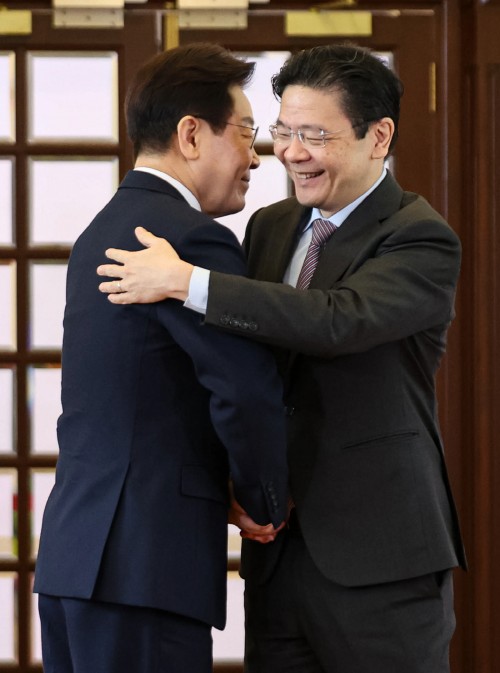 |
| President Lee Jae-myung and Singapore Prime Minister Lawrence Wong embrace after a joint press statement at Singapore’s Ministry of Foreign Affairs on March 2. / Yonhap |
President Lee Jae-myung and Singapore Prime Minister Lawrence Wong agreed Monday to pursue a bilateral artificial intelligence cooperation framework and expand collaboration in strategic sectors, including small modular reactors (SMRs).
During their summit in Singapore, the two leaders discussed upgrading the existing free trade agreement and deepening ties in advanced technologies, energy and security.
According to the presidential office, the countries will promote the signing of an “AI Cooperation Framework” aimed at accelerating joint research, investment and industrial innovation based on physical AI applications and real-world deployment of AI technologies.
The two sides signed five memorandums of understanding covering science and technology cooperation, AI and digital technology collaboration in public safety, enhanced intellectual property cooperation, joint use of environmental satellites, and SMR development.
Under the agreements, the countries will expand policy coordination and personnel exchanges in emerging fields such as quantum technology, SMRs and space and satellite technologies. They will also share information related to AI policy in public safety and support promising companies in the security and digital sectors.
The leaders also agreed to launch negotiations to upgrade the bilateral free trade agreement. Seoul plans to modernize trade cooperation in four key areas: supply chains, the green economy, trade facilitation and aviation maintenance, repair, overhaul and assembly (MRO).
In a joint press statement, Lee said, “I hope we can further solidify our existing cooperation in trade, investment and infrastructure, while expanding the horizon of collaboration into promising future sectors such as AI, nuclear energy and advanced science and technology.”
He added that both countries, long advocates of a free trade order in the region, agreed to strengthen economic solidarity, economic security cooperation and strategic investment ties.
Observers view the latest agreements as a step toward elevating bilateral economic relations into a comprehensive strategic partnership centered on next-generation technologies.
#Lee Jae-myung #Lawrence Wong #South Korea Singapore summit #AI cooperation framework
Copyright by Asiatoday
Most Read
-
1
Trump shares map on social media labeling Strait o..

-
2
Kia Sportage outperforms Mazda CX-5 in German auto..

-
3
Houthis launch successive attacks on Saudi airport..

-
4
U.S. deploys carrier, 10,000 more troops to Middle..

-
5
Trump rejects Iran's offer to open Strait of Hormu..

-
6
N. Korea conducts first swarm attack drill with dr..

-
7
U.S.-China summit falls short on substance as Trum..

PEOPLE





HEADLINE NEWS
- Seoul dismisses Ukraine's claim of 'S. Korean support for Russia' as "inaccurate and inappropriate"
- S. Korea, Japan race to develop nuclear-powered submarines
- Henri Kagan, Kenso Soai win Nobel Prize in Chemistry for uncovering how mol..
- Vance says Alaska LNG cooperation will move forward with Seoul's current or..

-
Address : In-Young Bldg., 34, Uisadang-daero 1-gil, Yeongdeungpo-gu, Seoul
Copyright by ASIATODAY CO., LTD. All rights resereved