



US leaves door open to ground war in Iran
Mar 03, 2026, 10:08 am


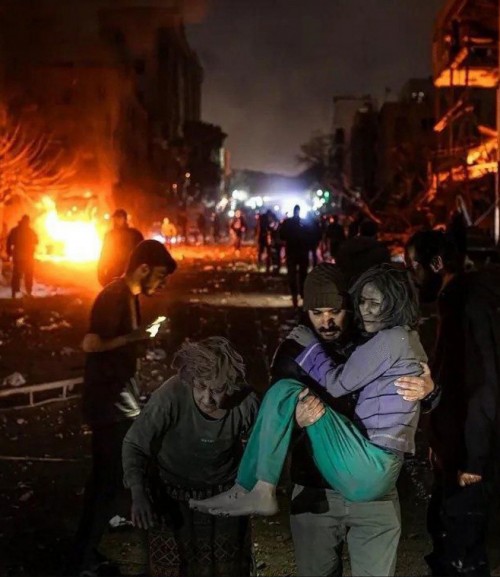 |
| Iranian citizens carry the wounded following U.S. and Israeli airstrikes in Tehran on March 2. / UPI–Yonhap |
U.S. President Donald Trump said the ongoing military campaign against Iran could last longer than initially expected and did not rule out deploying ground forces, even as administration officials denied it would become another “Iraq-style endless war.”
Speaking at a Medal of Honor ceremony at the White House on March 2, Trump said he had originally anticipated a four- to five-week operation but emphasized that the United States has the capacity to continue longer if necessary.
“It doesn’t matter how long it takes. Whatever it takes, we will get it done,” Trump said, underscoring that there is no fixed end date for the operation dubbed “Epic Fury.”
In an interview with the New York Post, Trump addressed the possibility of ground troop deployment, saying, “Other presidents said there would be no ground troops. I don’t have the ‘yips’ about ground forces.” He added that while such a move may not be necessary, “if needed, we could send them,” leaving the option on the table.
He also told CNN that “we haven’t even begun to hit them hard yet,” suggesting further large-scale strikes could follow.
Defense Secretary Pete Hegseth stressed at a Pentagon press briefing that the operation is “clear, destructive and decisive” and fundamentally different from the wars in Iraq and Afghanistan.
“This is not Iraq. This is not endless,” Hegseth said, adding that there would be “no nation-building quagmire” or “democracy-building exercise.”
However, he declined to specify a timeline for the campaign, saying the president retains sufficient latitude and that publicly defining the duration would not be appropriate.
The mixed messaging prompted The New York Times to describe the administration’s stance as “murky,” particularly regarding the potential for escalation.
Trump outlined four primary objectives for the campaign: dismantling Iran’s missile capabilities, crippling its naval forces, blocking pathways to nuclear weapons, and disrupting Tehran’s support and financing of armed groups beyond its borders.
While regime change was not explicitly listed as a goal, Hegseth remarked that although it is not officially a regime-change war, “the regime has certainly changed.”
U.S. military officials said the initial 24 hours of operations targeted more than 1,000 sites, achieving localized air superiority. B-2 strategic bombers flew 37-hour round trips from the U.S. mainland to deploy bunker-buster munitions on underground facilities. Two carrier strike groups, including the USS Abraham Lincoln and USS Gerald R. Ford, are participating in the campaign.
Casualties are mounting on multiple fronts. Trump confirmed four U.S. service members were killed during operations. Iran’s Red Crescent reported at least 555 deaths from U.S. and Israeli strikes. Hezbollah launched missile attacks toward Israel following the death of Supreme Leader Ali Khamenei, triggering retaliatory Israeli airstrikes in Lebanon.
The conflict has rattled global energy markets. With traffic through the Strait of Hormuz severely disrupted, West Texas Intermediate crude prices surged 6.5 percent. QatarEnergy halted liquefied natural gas production following drone attacks, sending European gas prices up 40 percent.
Air travel across the region has also been disrupted, with major hubs such as Dubai facing widespread cancellations.
As the third day of fighting unfolds, uncertainty over the duration and scope of the campaign continues to fuel concerns about a broader regional war.
#Donald Trump #Pete Hegseth #Iran conflict #Operation Epic Fury #Strait of Hormuz
Copyright by Asiatoday
Most Read
-
1
Celltrion nears additional contract with major U.S..

-
2
Putin proposes trilateral U.S.-China-Russia summit..

-
3
U.S. weighs dropping MOAB, world's most powerful n..

-
4
"Aren't those foreigners on welfare?": M..

-
5
Attention centers on APEC for possible Trump-Xi-Pu..

-
6
Saudi Arabia, Iran hold first diplomatic talks to..

-
7
U.S., Israel plan to resume strikes on Iran after..

PEOPLE







-
Address : In-Young Bldg., 34, Uisadang-daero 1-gil, Yeongdeungpo-gu, Seoul
Copyright by ASIATODAY CO., LTD. All rights resereved