



AI rally lifts Kospi past 6000 milestone
Feb 26, 2026, 07:52 am


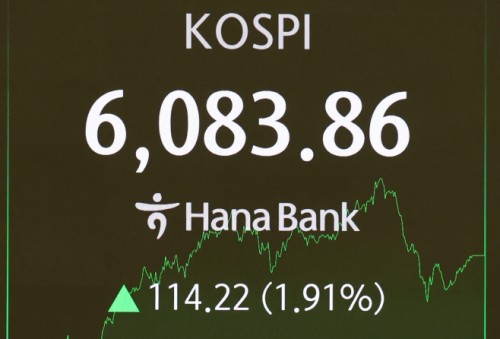 |
| The benchmark Kospi closes above the 6,000 mark for the first time on Feb. 25, as displayed on an electronic board at a dealing room in central Seoul. /Yonhap |
South Korea’s benchmark Kospi index closed above the 6,000 mark for the first time on Feb. 25, signaling not just a record high but a broad revaluation of industries propelled by the artificial intelligence transformation.
At the center of the rally are semiconductor giants Samsung Electronics and SK hynix, which together account for roughly 40 percent of the Kospi’s total market capitalization. Their shares have surged 70 percent and 58 percent, respectively, so far this year.
According to the Korea Exchange, the Kospi briefly surpassed 6,100 during intraday trading before closing above the historic 6,000 threshold.
Market watchers say this rally may differ from past semiconductor upcycles, which were often followed by sharp downturns. The current surge is closely tied to structural investment in AI infrastructure.
Unlike conventional memory chips — typically produced in advance and vulnerable to inventory-driven price swings — high-bandwidth memory (HBM), essential for AI accelerators, benefits from high technical barriers and surging demand from expanding data centers. Customized production for key clients has also reduced the risk of oversupply and abrupt price collapses.
Samsung Electronics and SK hynix are seen as leading not only in sixth-generation HBM4 but also in next-generation products, reinforcing expectations that the upcycle could last longer than previous booms.
The AI-driven rally has extended well beyond semiconductors.
Power equipment makers such as LS Electric, Hyosung Heavy Industries and HD Hyundai Electric have gained strongly amid rising electricity demand from data center expansion.
AI adoption in communications and defense has also fueled gains. Hanwha Systems, which is expanding satellite production, has seen its stock price double this year on expectations of AI-driven surveillance and command-and-control systems.
The momentum has spread to shipbuilding and defense, with companies benefiting from anticipated demand for AI-based combat systems and smart, unmanned vessels. Holding firms such as Hanwha Corporation and HD Hyundai have also posted sharp gains.
Investors are also revaluing companies positioned in so-called “physical AI,” where artificial intelligence is embedded in robotics and hardware.
Hyundai Motor shares have jumped 95 percent this year following the unveiling of humanoid robot technologies, while LG Electronics has risen 45 percent on expectations of expanded AI-enabled robotics and smart products.
While some analysts caution that short-term volatility cannot be ruled out after the rapid gains, many argue that the global expansion of AI investment represents a structural shift rather than a cyclical rebound.
In a recent report, Bridgewater Associates projected that major US technology firms will invest approximately $650 billion in AI infrastructure in 2026, underscoring that spending on AI-driven facilities, data centers and memory infrastructure is becoming a long-term structural trend.
#Kospi #Samsung Electronics #SK hynix #HBM #AI infrastructure
Copyright by Asiatoday
Most Read
-
1
Celltrion’s Omlyclo gains ground in major European..

-
2
Trump demands rates fall below 1% as Fed hikes for..

-
3
Trump makes $1 trillion bet ahead of midterm elect..

-
4
Iran resumes ballistic missile production, assembl..

-
5
Trump warns countries not helping U.S. must pay re..

-
6
Apple launches first foldable, 1 million won prici..

-
7
Turkish Airlines named main club partner of Liverp..

PEOPLE







-
Address : In-Young Bldg., 34, Uisadang-daero 1-gil, Yeongdeungpo-gu, Seoul
Copyright by ASIATODAY CO., LTD. All rights resereved