



NSSC review delays Kori reactors return
Feb 24, 2026, 07:26 am


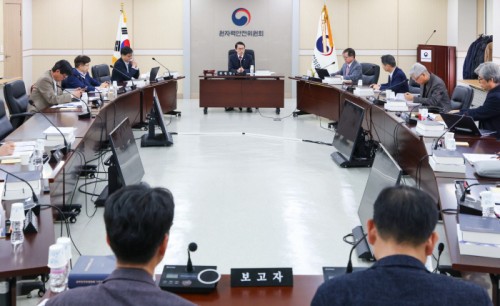 |
| The 2026-2nd Nuclear Safety and Security Commission meeting held on Feb. 12 at the NSSC conference hall in Seoul. / Nuclear Safety and Security Commission |
The restart of Kori Nuclear Power Plant Units 3 and 4 is unlikely within this year as the review process for continued operation remains in the safety assessment stage, according to industry sources.
While Kori Unit 2, which was granted approval for continued operation last November by the Nuclear Safety and Security Commission (NSSC), is set to resume operations around the third week of March following final equipment upgrades, Units 3 and 4 face a more prolonged review process.
Industry officials said on Feb. 23 that although Kori Unit 2 completed equipment replacements and design changes to accident response systems, Units 3 and 4 are still undergoing safety evaluations by the Korea Institute of Nuclear Safety (KINS). The review is expected to move to the Nuclear Safety Expert Committee around May or June, with the agenda for continued operation likely to be submitted to the NSSC in the second half of the year.
However, newly appointed non-standing commissioners recommended by the National Assembly — including experts critical of nuclear expansion — could lead to sharp differences in opinion during deliberations. If discussions are prolonged, as in the case of Kori Unit 1, a restart within the year could prove difficult, especially when additional facility improvement periods are taken into account.
Kori Unit 2, a 685-megawatt pressurized water reactor that began operations in 1983, was shut down in April 2023 after reaching the end of its design life. Upon resuming continued operation next month, it will be permitted to operate until April 8, 2033. Previously, Kori Unit 1 was granted a 10-year extension before being permanently shut down in 2017, while Wolsong Unit 1 received approval for continued operation until 2022 but was closed early in 2019.
An NSSC official said the commission is currently awaiting responses from Korea Hydro & Nuclear Power (KHNP) to KINS’ requests for clarification and supplementary materials. “The duration of the safety review varies depending on the specifics of the case,” the official said, adding that prior experience with Kori Unit 2 could help shorten the preliminary review period.
Meanwhile, the NSSC plans to simultaneously submit the accident management plan approval for Kori Units 3 and 4 alongside the continued operation agenda in the second half of the year. The accident management plan, introduced through a revision to the Nuclear Safety Act in 2015 following the Fukushima disaster, outlines procedures for responding to severe nuclear accidents.
Although all domestic nuclear plants submitted such plans in 2019, reviews were repeatedly delayed. Kori Unit 2 became the first to receive NSSC approval last year.
Critics argue that the review of accident management plans has been postponed indefinitely despite the urgent need to strengthen safety management for aging domestic reactors. In the case of Wolsong Unit 4, its plan is not expected to undergo review until after its operating license expires in 2029.
The NSSC said that since continued operation reviews already include measures for severe accident response, the accident management plan cannot diverge from those contents. “Under the current circumstances, the agenda for Kori Units 3 and 4 will be submitted simultaneously,” the commission said.
#Kori nuclear power plant #Kori Units 3 and 4 #Kori Unit 2 #Nuclear Safety and Security Commission
Copyright by Asiatoday
Most Read
-
1
Trump shares map on social media labeling Strait o..

-
2
Kia Sportage outperforms Mazda CX-5 in German auto..

-
3
Houthis launch successive attacks on Saudi airport..

-
4
U.S. deploys carrier, 10,000 more troops to Middle..

-
5
Trump rejects Iran's offer to open Strait of Hormu..

-
6
N. Korea conducts first swarm attack drill with dr..

-
7
U.S.-China summit falls short on substance as Trum..

PEOPLE





HEADLINE NEWS
- Seoul dismisses Ukraine's claim of 'S. Korean support for Russia' as "inaccurate and inappropriate"
- S. Korea, Japan race to develop nuclear-powered submarines
- Henri Kagan, Kenso Soai win Nobel Prize in Chemistry for uncovering how mol..
- Vance says Alaska LNG cooperation will move forward with Seoul's current or..

-
Address : In-Young Bldg., 34, Uisadang-daero 1-gil, Yeongdeungpo-gu, Seoul
Copyright by ASIATODAY CO., LTD. All rights resereved