



Lee clears semiconductor act, July 17 holiday returns
Feb 04, 2026, 07:41 am


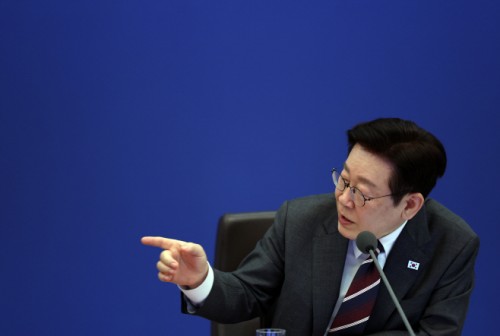 |
| President Lee Jae-myung speaks during a Cabinet meeting at Cheong Wa Dae on Feb. 3. / Yonhap |
President Lee Jae-myung on Feb. 3 presided over a Cabinet meeting that approved a special bill aimed at strengthening South Korea’s semiconductor industry, while also restoring Constitution Day on July 17 as a public holiday.
At the fourth Cabinet meeting of the year, held at the Sejong Room of Cheong Wa Dae, the Cabinet passed a partial revision to the Act on Public Holidays, officially designating Constitution Day as a national holiday. With the decision, all five major national days — March 1 Independence Movement Day, Constitution Day on July 17, Liberation Day on Aug. 15, National Foundation Day on Oct. 3 and Hangeul Day on Oct. 9 — are now public holidays.
The government has pushed to reinstate Constitution Day as a holiday since last year, citing the need to provide an annual opportunity for the public to reflect on the spirit of the Constitution.
Although Constitution Day commemorates the promulgation of the Constitution in 1948, it was removed from the list of statutory public holidays starting in 2008. The change followed discussions during the Roh Moo-hyun administration to reduce the number of public-sector holidays after the introduction of the five-day workweek.
President Lee previously raised the issue on July 17 last year, during a meeting with senior presidential aides marking the 77th anniversary of Constitution Day. At the time, he said, “Constitution Day is the only national day referred to as a ‘jeol’ that is not a public holiday, despite commemorating the promulgation of the Constitution,” adding that the designation of the day as a holiday should be reviewed.
The Cabinet’s decision followed approval by the National Assembly on Jan. 29, when lawmakers passed the revised Public Holidays Act with 198 votes in favor, two against and three abstentions out of 203 lawmakers present.
The Cabinet also approved several industry and social policy bills. The Special Act on Strengthening and Supporting the Competitiveness of the Semiconductor Industry establishes a presidential committee dedicated to semiconductor competitiveness and allows semiconductor cluster infrastructure projects to be exempted from, or given priority in, preliminary feasibility studies.
In addition, a revision to the Copyright Act classifies the operation of websites that provide links to pirated content as copyright infringement and allows courts to award damages of up to five times the assessed loss.
The Cabinet also passed an amendment to the Enforcement Decree of the Child Abuse Punishment Act, which allows authorities to impose fines of up to 10 million won on offenders who fail to comply with temporary measures such as mandatory counseling or education.
#Lee Jae-myung #Cabinet meeting #semiconductor special act #Constitution Day #public holiday
Copyright by Asiatoday
Most Read
-
1
Trump shares map on social media labeling Strait o..

-
2
Kia Sportage outperforms Mazda CX-5 in German auto..

-
3
Houthis launch successive attacks on Saudi airport..

-
4
U.S. deploys carrier, 10,000 more troops to Middle..

-
5
Trump rejects Iran's offer to open Strait of Hormu..

-
6
N. Korea conducts first swarm attack drill with dr..

-
7
U.S.-China summit falls short on substance as Trum..

PEOPLE





HEADLINE NEWS
- Seoul dismisses Ukraine's claim of 'S. Korean support for Russia' as "inaccurate and inappropriate"
- S. Korea, Japan race to develop nuclear-powered submarines
- Henri Kagan, Kenso Soai win Nobel Prize in Chemistry for uncovering how mol..
- Vance says Alaska LNG cooperation will move forward with Seoul's current or..

-
Address : In-Young Bldg., 34, Uisadang-daero 1-gil, Yeongdeungpo-gu, Seoul
Copyright by ASIATODAY CO., LTD. All rights resereved