



Han pushes 90 bills to deliver Lee agenda
Jan 29, 2026, 10:42 am


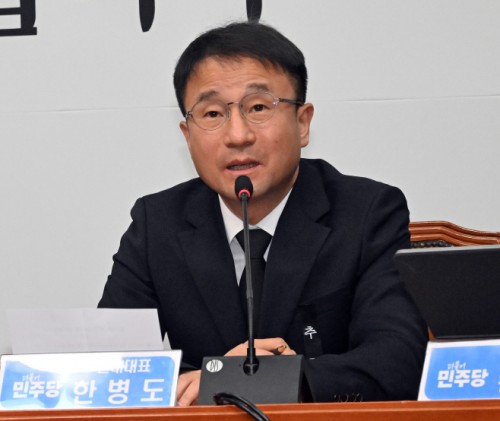 |
| Han Byung-do, floor leader of the Democratic Party, speaks at a party leadership meeting at the National Assembly on Jan. 26. /Song Eui-joo |
Han Byung-do, floor leader of the Democratic Party, said Wednesday that the National Assembly would pass 90 non-controversial livelihood bills at a plenary session, pledging to complete the key policy agenda of the Lee Jae-myung administration at speed.
Speaking at a policy coordination meeting, Han said the Assembly would process the 90 bills along with revisions to the National Assembly Act. “No matter how strong the government’s will to govern, if the National Assembly fails to support it through legislation, the pain ultimately falls on the people,” he said. “We will complete the administration’s policy agenda with urgency.”
With dozens of livelihood-related bills still pending, Han urged the People Power Party to cooperate more proactively. He cited President Lee’s recent remarks that the pace of legislation has failed to keep up with the speed of policy implementation, saying the Democratic Party would “prove the success of the Lee administration through results” and calling on the opposition to assist in passing the remaining bills.
Han also criticized a first-instance court ruling handed down the previous day against Kim Keon-hee. “This ruling completely ignored the essence of Kim Keon-hee as an unelected power broker and, in effect, a co-manager of the administration,” he said, adding that the court turned a blind eye to allegations of stock manipulation and the free receipt of opinion polls linked to the Myeong Tae-gyun case. “It is deeply regrettable,” he said.
He stressed that higher courts now bear a heavy responsibility to correct what he called the truth overlooked at the first trial, and argued that the justification for launching a second comprehensive special prosecutor investigation has been strengthened. “Through a comprehensive probe, we will prove to the end that no one stands above the law,” he said.
On U.S.-Korea tariff talks, Han accused the People Power Party of obstructing state affairs by insisting on parliamentary ratification. “They are dragging out time by putting a lock of ratification on a non-binding memorandum of understanding,” he said. “While the U.S. president can respond flexibly through executive orders, tying ourselves down with ratification runs directly counter to the national interest.”
#Han Byung-do #Democratic Party #livelihood bills #National Assembly #Lee Jae-myung administration
Copyright by Asiatoday
Most Read
-
1
Trump shares map on social media labeling Strait o..

-
2
Kia Sportage outperforms Mazda CX-5 in German auto..

-
3
Houthis launch successive attacks on Saudi airport..

-
4
U.S. deploys carrier, 10,000 more troops to Middle..

-
5
Trump rejects Iran's offer to open Strait of Hormu..

-
6
N. Korea conducts first swarm attack drill with dr..

-
7
U.S.-China summit falls short on substance as Trum..

PEOPLE





HEADLINE NEWS
- Seoul dismisses Ukraine's claim of 'S. Korean support for Russia' as "inaccurate and inappropriate"
- S. Korea, Japan race to develop nuclear-powered submarines
- Henri Kagan, Kenso Soai win Nobel Prize in Chemistry for uncovering how mol..
- Vance says Alaska LNG cooperation will move forward with Seoul's current or..

-
Address : In-Young Bldg., 34, Uisadang-daero 1-gil, Yeongdeungpo-gu, Seoul
Copyright by ASIATODAY CO., LTD. All rights resereved