



U.S. reaffirms tariff pressure on Korea over approval delay
Jan 29, 2026, 10:36 am


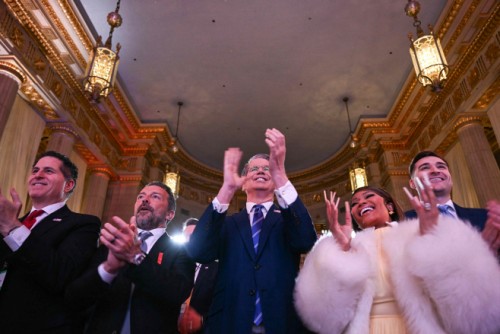 |
| U.S. Treasury Secretary Scott Bessent (center), Dell CEO Michael Dell (left), and rapper-singer Nicki Minaj applaud as U.S. President Donald Trump arrives to speak about the “Trump account” at the Andrew W. Mellon Auditorium in Washington, D.C., on Jan. 28. /AFP-Yonhap |
U.S. Treasury Secretary Scott Bessent said Tuesday that there is no trade agreement with South Korea unless the country’s National Assembly ratifies it, reaffirming Washington’s tariff pressure on Seoul.
In an interview with CNBC, Bessent was asked whether President Donald Trump was raising tariffs on South Korea because it had failed to approve a trade deal. “Because the Korean National Assembly has not passed the trade agreement, there is no trade deal with Korea until they approve it,” he said.
Bessent repeatedly used the term “ratify,” underscoring that the issue lies with the South Korean legislature. “Sign the trade deal,” he said, adding again that “there is no deal until ratification.”
Asked whether South Korea would face a 25 percent tariff until ratification is completed, Bessent replied, “I think that helps move the situation forward,” a remark widely interpreted as indicating that tariff hikes are being used to pressure the National Assembly to approve the agreement.
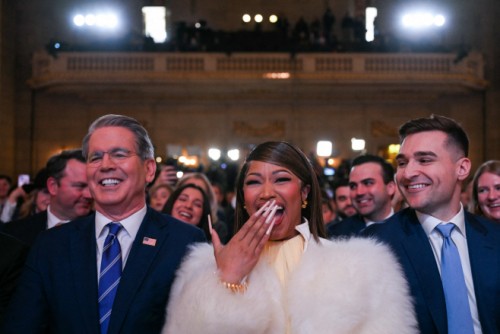 |
| U.S. Treasury Secretary Scott Bessent (left) and rapper-singer Nicki Minaj smile as President Donald Trump speaks about the “Trump account” at the Andrew W. Mellon Auditorium in Washington, D.C., on Jan. 28. /AFP-Yonhap |
His comments clarified the background to President Trump’s announcement on Jan. 26 that the United States would raise reciprocal tariffs on Korean products. On Truth Social, Trump wrote that “the Korean legislature has not legislated our historic trade deal,” and said tariffs on Korean automobiles, timber, pharmaceuticals and other products would be increased from 15 percent to 25 percent.
At the same time, Trump suggested room for negotiations, saying on Jan. 27 that the two sides would “work out a solution.” As of now, no executive order or official notice to implement the tariff increase has been issued.
The Trump administration is also reportedly stepping up pressure beyond ratification, including calls for South Korea to ease regulations on U.S. technology firms such as Coupang, according to a report by The Wall Street Journal. The newspaper said Vice President J.D. Vance told Prime Minister Kim Min-seok during a White House meeting on Jan. 23 that Washington wanted meaningful “de-escalation” in how Seoul treats U.S. tech companies.
The South Korean government has mobilized its full trade policy team to assess Washington’s intentions. Industry Minister Kim Jeong-gwan is scheduled to travel to Washington later Tuesday to meet U.S. Commerce Secretary Howard Lutnick, while Trade Minister Yeo Han-koo plans talks with the Office of the U.S. Trade Representative.
#Scott Bessent #U.S. Treasury #South Korea #ratification #tariffs
Copyright by Asiatoday
Most Read
-
1
Trump shares map on social media labeling Strait o..

-
2
Kia Sportage outperforms Mazda CX-5 in German auto..

-
3
Houthis launch successive attacks on Saudi airport..

-
4
U.S. deploys carrier, 10,000 more troops to Middle..

-
5
Trump rejects Iran's offer to open Strait of Hormu..

-
6
N. Korea conducts first swarm attack drill with dr..

-
7
U.S.-China summit falls short on substance as Trum..

PEOPLE




HEADLINE NEWS
- Seoul dismisses Ukraine's claim of 'S. Korean support for Russia' as "inaccurate and inappropriate"
- S. Korea, Japan race to develop nuclear-powered submarines
- Henri Kagan, Kenso Soai win Nobel Prize in Chemistry for uncovering how mol..
- Vance says Alaska LNG cooperation will move forward with Seoul's current or..

-
Address : In-Young Bldg., 34, Uisadang-daero 1-gil, Yeongdeungpo-gu, Seoul
Copyright by ASIATODAY CO., LTD. All rights resereved