



YouTube content to face media arbitration process
Jan 28, 2026, 09:56 am


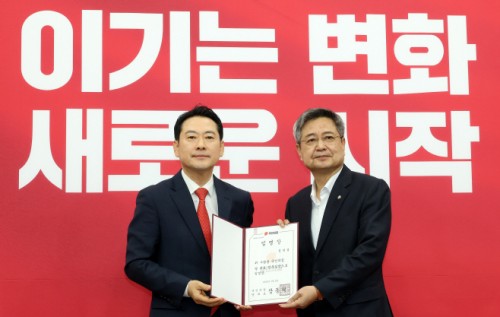 |
| People Power Party floor leader Jang Dong-hyuk poses for a photo with Kim Jang-gyeom, chief of the party leader’s political affairs office, after presenting him with a letter of appointment at a party leadership meeting at the National Assembly on Jan. 15. / Yonhap |
Lawmakers moved to expand remedies for victims of online defamation as Rep. Kim Jang-gyeom introduced a bill that would allow correction and rebuttal requests for influential online content, including YouTube videos, through the media arbitration system.
According to political sources on Tuesday, Kim, a member of the National Assembly’s science and ICT committee, submitted an amendment dubbed the “Cyber Wrecker Victim Relief Act.” The proposal revises the Media Arbitration Act to create procedures enabling victims to seek corrections, rebuttals or follow-up information postings from online content publishers, or to apply for mediation and arbitration by the Press Arbitration Commission.
The move comes amid a surge in harm linked to online misinformation as platforms such as YouTube and social media rival traditional media in influence. Unverified claims have fueled defamation, privacy violations and cyberbullying, often triggering secondary damage to victims.
So-called “cyber wreckers” have been cited as a key driver—accounts that spread sensational falsehoods or orchestrate targeted attacks to boost views, influence and ad revenue.
Police data underscore the trend. Cases of online defamation and insult rose 229.5 percent over the past decade, from 8,880 incidents in 2014 to 29,258 in 2023, heightening calls for effective victim protections.
Under the bill, the scope of media arbitration would expand beyond traditional news to online information with high dissemination potential. If mediation or arbitration fails, victims could pursue expedited civil litigation, with courts required to issue rulings within three months, similar to existing procedures for correction claims.
Eligibility would cover content posted by online publishers that exceed thresholds for average views, subscribers or annual revenue, as well as individual posts whose views or shares surpass set levels—aimed at ensuring swift relief from high-impact harm while avoiding undue constraints on ordinary users’ freedom of expression.
If enacted, the measure would allow victims to seek faster, more practical remedies without getting bogged down in debates over whether one-person media outlets qualify as “press.”
“Information distribution via platforms like YouTube is an area where freedom of expression and personal dignity collide,” Kim said. “Rather than pushing disputes toward extremes such as punitive damages, providing mediation that encourages dialogue and compromise better aligns with constitutional principles.”
He added that policy efforts had long stalled over arguments about treating YouTubers as media, but said victims harmed by cyber wreckers “can no longer be left without protection.”
#YouTube #online defamation #cyber wrecker #media arbitration #correction request
Copyright by Asiatoday
Most Read
-
1
Trump shares map on social media labeling Strait o..

-
2
Kia Sportage outperforms Mazda CX-5 in German auto..

-
3
Houthis launch successive attacks on Saudi airport..

-
4
U.S. deploys carrier, 10,000 more troops to Middle..

-
5
Trump rejects Iran's offer to open Strait of Hormu..

-
6
N. Korea conducts first swarm attack drill with dr..

-
7
U.S.-China summit falls short on substance as Trum..

PEOPLE






HEADLINE NEWS
- Seoul dismisses Ukraine's claim of 'S. Korean support for Russia' as "inaccurate and inappropriate"
- S. Korea, Japan race to develop nuclear-powered submarines
- Henri Kagan, Kenso Soai win Nobel Prize in Chemistry for uncovering how mol..
- Vance says Alaska LNG cooperation will move forward with Seoul's current or..

-
Address : In-Young Bldg., 34, Uisadang-daero 1-gil, Yeongdeungpo-gu, Seoul
Copyright by ASIATODAY CO., LTD. All rights resereved