



Iran retaliation spreads as embassies close and oil surges
Mar 04, 2026, 09:57 am


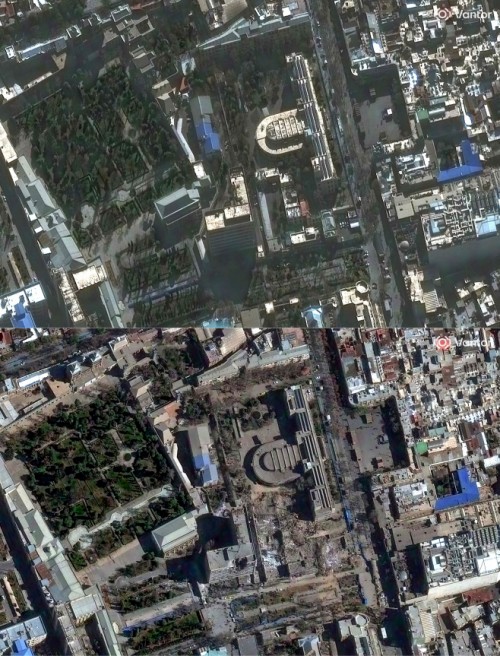 |
| A combination of satellite images provided by Vantor on March 3 shows Iran’s judiciary complex in Tehran on March 1 (top) and the same site after U.S. and Israeli airstrikes on March 3. / AFP–Yonhap |
Large-scale military strikes by the United States and Israel against Iran entered their fourth day on March 3, as Tehran launched retaliatory attacks across the Gulf region and Lebanon, raising fears of a broader Middle East war.
Iran’s drone and missile strikes targeting U.S. diplomatic facilities and Gulf states prompted Washington to close embassies in several countries and order American citizens to leave parts of the region.
Strikes target Iranian nuclear and military sites
Israeli forces reportedly struck multiple locations in Tehran, including facilities linked to the state broadcaster IRIB, areas near Mehrabad Airport and underground nuclear development sites.
Airstrikes also damaged buildings in Qom associated with the Assembly of Experts, the body responsible for selecting a successor to Iran’s supreme leader Ali Khamenei.
U.S. President Donald Trump said the attacks had severely degraded Iran’s capabilities.
“Almost everything has been neutralized,” Trump told reporters, referring to Iran’s military infrastructure.
Iran retaliates across the region
Iran responded by launching dozens of ballistic missiles toward Israel and carrying out drone attacks across Gulf countries.
A drone strike reportedly hit the roof of the U.S. Embassy in Riyadh, Saudi Arabia, partially collapsing the structure. Additional drone attacks caused fires at a U.S. consulate parking lot in Dubai and near the U.S. Embassy in Kuwait.
U.S. Secretary of State Marco Rubio said American diplomatic facilities were under direct attack by what he called a “terror regime.”
As tensions escalated, Washington closed its embassies in Saudi Arabia, Kuwait and Lebanon and urged Americans in several Middle Eastern countries to depart immediately.
Fighting spreads to Lebanon
The conflict is also expanding into Lebanon after the Iran-backed militant group Hezbollah launched attack drones toward Israel.
In response, Israeli forces carried out airstrikes on weapons storage facilities in Beirut and expanded ground operations in southern Lebanon.
Casualties have mounted rapidly. Iran’s Red Crescent said at least 787 people have been killed since the strikes began. More than 40 people have died in Lebanon, while at least six U.S. troops and 10 people in Israel have also been reported killed.
Oil prices surge amid Hormuz fears
The escalating conflict has also disrupted global energy markets, with concerns rising that Iran could restrict shipping through the Strait of Hormuz.
Brent crude prices jumped about 4.7 percent to $81.40 per barrel, while U.S. West Texas Intermediate rose to $74.56.
Trump said the U.S. Navy could escort oil tankers through the strait if necessary.
“If needed, the U.S. Navy will begin escorting tankers as quickly as possible,” he said.
Uncertainty over Iran’s leadership
Trump also hinted at possible political change within Iran following the attacks.
“Most of the succession candidates we had considered are dead,” he said, suggesting that someone within the Iranian government could take power in a post-conflict scenario.
#Iran conflict #United States #Israel #Donald Trump #Middle East escalation
Copyright by Asiatoday
Most Read
-
1
Trump shares map on social media labeling Strait o..

-
2
Kia Sportage outperforms Mazda CX-5 in German auto..

-
3
Houthis launch successive attacks on Saudi airport..

-
4
U.S. deploys carrier, 10,000 more troops to Middle..

-
5
Trump rejects Iran's offer to open Strait of Hormu..

-
6
N. Korea conducts first swarm attack drill with dr..

-
7
U.S.-China summit falls short on substance as Trum..

PEOPLE






HEADLINE NEWS
- Seoul dismisses Ukraine's claim of 'S. Korean support for Russia' as "inaccurate and inappropriate"
- S. Korea, Japan race to develop nuclear-powered submarines
- Henri Kagan, Kenso Soai win Nobel Prize in Chemistry for uncovering how mol..
- Vance says Alaska LNG cooperation will move forward with Seoul's current or..

-
Address : In-Young Bldg., 34, Uisadang-daero 1-gil, Yeongdeungpo-gu, Seoul
Copyright by ASIATODAY CO., LTD. All rights resereved