



Samsung vs SK Hynix: battle for AI memory crown
Jan 28, 2026, 09:54 am


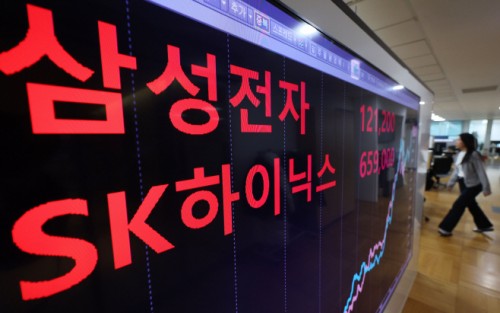 |
| Screens at the Yonhap Infomax building in Jongno, Seoul, show intraday record highs for Samsung Electronics and SK Hynix on Dec. 30, 2025. / Yonhap |
Samsung Electronics and SK Hynix will release their fourth-quarter earnings on the same day, Jan. 29, a rare coincidence that global media see as a key test of leadership in the intensifying race for artificial intelligence (AI) memory chips.
Bloomberg reported on Jan. 27 that the simultaneous earnings announcements mark the latest phase in a high-stakes competition over AI memory, as demand for high-performance chips surges with the expansion of AI servers and data centers.
According to Bloomberg, the results are expected to highlight booming demand for advanced memory used in AI infrastructure, while also reflecting a broader electronics industry trend in which memory prices are rising sharply as manufacturers concentrate on cutting-edge production.
The Financial Times similarly noted in a Jan. 25 report that the recent rally in memory stocks reflects a shift of capital from big tech into memory makers amid the AI boom, as insatiable chip demand and supply shortages turn memory into a structural bottleneck for AI systems.
Bloomberg said the memory industry—once defined by extreme boom-and-bust cycles—has entered a markedly different phase, generating profit levels that would have seemed unimaginable just a few years ago.
Stock performance underscores the shift. Bloomberg data show that since early September last year, shares of Samsung Electronics have risen about 130 percent, while SK Hynix shares have surged nearly threefold.
The Financial Times reported that since last August, shares of Sandisk have climbed nearly 1,100 percent, while SK Hynix, along with Micron and Western Digital, has roughly tripled over the same period.
Bloomberg consensus estimates suggest SK Hynix will post the sharpest quarter-on-quarter improvement in the fourth quarter. Analysts expect its operating profit to reach 16.6 trillion won, double the previous quarter, with revenue rising more than 50 percent to 31.1 trillion won. The gains are attributed to its dominance in HBM3E, the most advanced high-bandwidth memory currently used by Nvidia and major cloud operators.
Samsung Electronics, meanwhile, is seen entering a phase of broad-based recovery as the rebound in the memory market spreads across its semiconductor business. Bloomberg forecasts operating profit of 10.85 trillion won for Samsung’s Device Solutions division in the fourth quarter. Earlier this month, Samsung signaled in preliminary results that its memory business—long pressured by weak pricing and excess inventory—was coming back to life.
Bloomberg noted that record supply shortages in both DRAM and NAND have significantly strengthened pricing power for memory makers.
Timothy Moe, Asia-Pacific equity strategy head at Goldman Sachs, said the current “supernormal” profit environment could extend into next year, arguing that as AI spreads across more industries, “there is a strong case that this cycle could be stronger and last longer.”
At the core of the rivalry is high-bandwidth memory. In the fourth quarter, SK Hynix maintained a clear lead in the HBM3E market, while Samsung is aiming to close the gap with next-generation HBM4.
Samsung’s HBM4 is expected to be integrated with Nvidia’s next flagship “Rubin” processor and is reportedly close to receiving certification from Nvidia.
Richard Clode, a portfolio manager at Janus Henderson, said Samsung’s dominance in global DRAM capacity—about 50 percent—has long fueled expectations that Nvidia would eventually certify Samsung products, noting that “it is difficult to execute Nvidia’s growth roadmap without the support of the largest memory supplier.”
Bloomberg reported that foreign investors are increasing their exposure to Samsung Electronics while trimming positions in SK Hynix. The shift suggests that much of SK Hynix’s HBM-driven upside has already been priced in, whereas Samsung’s earnings recovery is now entering a more decisive phase.
Citi analysts forecast average selling prices for DRAM to rise 120 percent this year and NAND prices to jump 90 percent, prompting them to raise their target prices for SK Hynix by 56 percent and for Samsung Electronics by 20 percent, Bloomberg said.
SK Hynix is scheduled to announce earnings at 9 a.m. on Jan. 29, followed by Samsung Electronics at 10 a.m. the same day.
#Samsung Electronics #SK Hynix #AI memory #HBM #earnings
Copyright by Asiatoday
Most Read
-
1
Kia Sportage outperforms Mazda CX-5 in German auto..

-
2
Houthis launch successive attacks on Saudi airport..

-
3
Saudi Arabia, Iran hold first diplomatic talks to..

-
4
U.S. deploys carrier, 10,000 more troops to Middle..

-
5
Saudi airport in Riyadh struck again, leaving at l..

-
6
Putin's ally visits China on the 8th ahead of APEC..

-
7
Chinese military support and training center opens..

PEOPLE






HEADLINE NEWS

-
Address : In-Young Bldg., 34, Uisadang-daero 1-gil, Yeongdeungpo-gu, Seoul
Copyright by ASIATODAY CO., LTD. All rights resereved