



SK hynix triples as AI shifts to memory
Jan 26, 2026, 08:56 am


 |
| The logo of SK hynix is seen in a photo taken on Aug. 25, 2025. / Reuters–Yonhap |
High-performance memory and data storage stocks are emerging as the “next winners” of the artificial intelligence rally, drawing growing investor attention as demand surges amid persistent supply constraints.
According to the Financial Times on Jan. 25, the rally reflects a combination of “insatiable” demand for chips and tight supply conditions. Capital that once flowed primarily into big technology companies is now shifting rapidly toward hardware infrastructure, particularly memory and storage.
Within this trend, SK hynix has established itself as a leading beneficiary alongside U.S.-based Micron and Western Digital, all of which have seen their share prices triple over the same period.
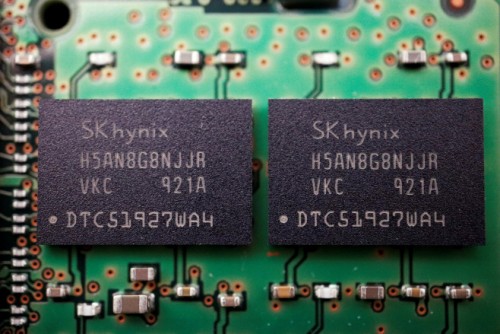 |
| Memory chips produced by SK hynix are shown on a circuit board, highlighting their role in AI data processing. / Reuters–Yonhap |
The FT noted that global spending on AI infrastructure is expected to exceed $500 billion this year. Long considered an “unglamorous and less innovative” segment of the IT hardware market, data storage manufacturers have seen their valuations surge over recent months as massive investment pours into AI infrastructure.
The report highlighted that memory stocks continued to rise even as the share price momentum of major technology firms slowed, underscoring a shift in investor focus.
SK hynix’s performance stands out numerically. FT data show that SanDisk has led the rally, with its stock nearly doubling since early January and soaring nearly 1,100 percent since last August, helped by spin-off effects. Close behind, global memory makers have moved in tandem, with SK hynix, Micron and Western Digital each posting roughly threefold gains.
Based on an FT “rebased” share price chart as of Feb. 13, 2025, SK hynix’s trajectory closely mirrors that of Micron, suggesting that markets increasingly view the company not as a thematic play but as a fundamental supplier of indispensable AI infrastructure components.
On the chart, SK hynix sits in the roughly +250 to +300 percent range, outperforming Seagate and forming a solid top-tier group with Micron and Western Digital. The FT said this reflects a shift in investor attention toward core components facing the tightest supply constraints, rather than a broad basket of AI-exposed stocks.
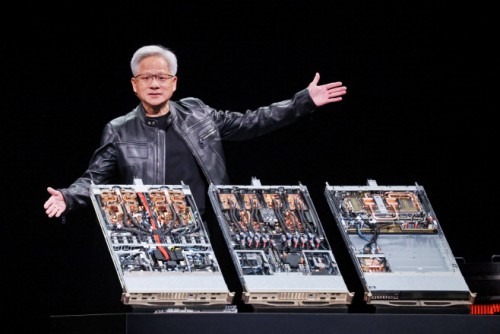 |
| Jensen Huang, CEO of Nvidia, delivers a keynote speech, underscoring the growing importance of memory in AI infrastructure. / AFP–Yonhap |
Momentum in the sector was further fueled by comments from Jensen Huang, chief executive of Nvidia. The FT noted that the rally reignited when Huang said that holding the world’s AI working memory could effectively become “the world’s largest storage market.”
The FT described SK hynix, Samsung Electronics, and Micron as key producers of fast “solid-state” memory chips and core partners in Nvidia’s ecosystem. These chips are essential for supplying data to Nvidia processors used to train and run large-scale AI systems, including large language models underpinning OpenAI’s ChatGPT.
Analysts say SK hynix’s role in continuously feeding data to Nvidia’s graphics processing units has been a fundamental driver behind its threefold share price increase.
Market experts broadly agree the rally is not a short-lived phenomenon. As AI capital expenditure continues, memory is increasingly becoming a performance bottleneck for entire systems.
Arun Sai, a multi-asset strategist at Pictet, described recent months as “jaw-dropping by any standard,” noting that the market narrative has shifted toward memory becoming the choke point in sustained AI infrastructure build-outs.
At the World Economic Forum in Davos, Arm CEO Rene Haas told the FT that use cases for high-bandwidth memory in AI have “exploded,” adding that demand remains far from being met.
Supply, however, has been slow to respond. Memory manufacturers are reluctant to invest aggressively in costly new fabrication plants due to the industry’s characteristic cycle of swinging “from shortage to glut.”
Richard Clode, a technology portfolio manager at Janus Henderson, warned that, as with other commodities, prices could eventually “go crazy.” Ben Bajarin of Creative Strategies predicted that supply shortages would persist at least through 2028, signaling a prolonged boom for memory companies including SK hynix.
FT data further illustrate a clear handover of market leadership from big tech to memory. Since last September, memory stocks such as SanDisk, Micron, Western Digital and SK hynix have far outperformed tech giants including Alphabet, Amazon and Microsoft.
Sai said the AI trade is no longer about holding a simple basket of exposed stocks, adding that “the market has become much better at distinguishing winners from losers,” signaling a shift in the paradigm of AI investing.
Hedge funds are estimated to have anticipated the move early. The FT reported that firms such as D. E. Shaw, Renaissance Technologies and Arrowstreet Capital likely generated billions of dollars in gains by betting early on memory and storage stocks, a move the paper likened to the massive profits earned from early bets on Nvidia in early 2024.
#AI rally #memory chips #SK hynix #Micron #Western Digital
Copyright by Asiatoday
Most Read
-
1
Kia Sportage outperforms Mazda CX-5 in German auto..

-
2
Houthis launch successive attacks on Saudi airport..

-
3
Saudi Arabia, Iran hold first diplomatic talks to..

-
4
U.S. deploys carrier, 10,000 more troops to Middle..

-
5
Saudi airport in Riyadh struck again, leaving at l..

-
6
Putin's ally visits China on the 8th ahead of APEC..

-
7
Chinese military support and training center opens..

PEOPLE






HEADLINE NEWS

-
Address : In-Young Bldg., 34, Uisadang-daero 1-gil, Yeongdeungpo-gu, Seoul
Copyright by ASIATODAY CO., LTD. All rights resereved