



Public backs nuclear power, new plants likely
Jan 22, 2026, 07:56 am


 |
Nearly eight in 10 South Koreans say nuclear power is necessary, according to a nationwide survey, bolstering expectations that the government will proceed with plans to build new nuclear power plants as scheduled.
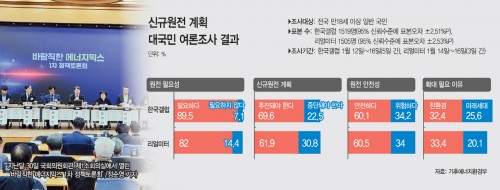
The Ministry of Climate, Energy and Environment on Tuesday released results of public opinion polls conducted last week on new nuclear facilities included in the 11th Basic Plan for Power Supply and Demand. The survey covered about 3,000 respondents, split between telephone interviews by Gallup Korea (1,519 people) and automated response surveys by Realmeter (1,505), with samples weighted by gender, age and region to ensure representativeness.
In the polls, 89.5% (Gallup) and 82.0% (Realmeter) of respondents said nuclear power is necessary. Support for building new nuclear plants reached 69.6% and 61.9%, respectively—figures close to what President Lee Jae-myung described as “overwhelming approval” at a Cabinet meeting a day earlier.
Public perceptions of safety were also relatively positive. More than half of respondents—60.1% and 60.5%—said nuclear power is generally safe, while about one-third—34.2% and 34.0%—viewed it as dangerous. The results suggest a notable gap between public sentiment and the risk concerns often emphasized by anti-nuclear civic groups.
When asked which power sources should be expanded, renewable energy ranked first at 48.9% and 43.1%, followed closely by nuclear power at 38.0% and 41.9%. Liquefied natural gas (LNG), commonly seen as a backup for renewables, placed third at 5.6% and 6.7%. The most cited reason for expansion was environmental friendliness, at 32.4% and 33.4%.
The government had earlier stepped back from plans to suspend new nuclear construction under the 11th power plan after public backlash, opting instead to seek consensus through town hall meetings and surveys. With both forums and polling showing strong support for nuclear power, officials are expected to move ahead with new builds. The ministry said it will announce detailed implementation measures soon.
At public discussions, participants broadly agreed that while renewable energy expansion is essential, its technical limits and intermittency mean nuclear power and LNG remain indispensable.
Jeong Yong-hoon, a professor at KAIST, warned that policies forcing consumers to absorb higher electricity costs without transparency risk resembling a de facto nuclear phase-out. Han Byeong-seop, head of the Nuclear Safety Research Institute, said energy policy should prioritize public acceptance by first focusing on efficiency and conservation before finalizing an optimal energy mix.
#nuclear power #public opinion survey #new nuclear plants #energy mix #renewable energy
Copyright by Asiatoday
Most Read
-
1
Celltrion nears additional contract with major U.S..

-
2
Putin proposes trilateral U.S.-China-Russia summit..

-
3
U.S. weighs dropping MOAB, world's most powerful n..

-
4
"Aren't those foreigners on welfare?": M..

-
5
Attention centers on APEC for possible Trump-Xi-Pu..

-
6
Saudi Arabia, Iran hold first diplomatic talks to..

-
7
U.S., Israel plan to resume strikes on Iran after..

PEOPLE





-
Address : In-Young Bldg., 34, Uisadang-daero 1-gil, Yeongdeungpo-gu, Seoul
Copyright by ASIATODAY CO., LTD. All rights resereved