



Government designates Lee stabbing as terrorism
Jan 21, 2026, 07:49 am


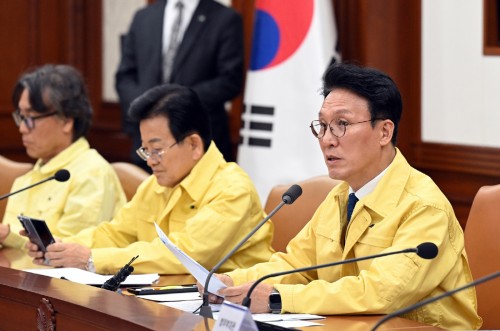 |
| Prime Minister Kim Min-seok speaks during a meeting of the National Counterterrorism Committee at the Government Complex Seoul on Jan. 20. / Park Sung-il |
South Korea has officially designated the stabbing attack on President Lee Jae-myung as terrorism for the first time since the launch of the National Counterterrorism Committee, a decision that comes amid growing criticism that the body lacks real authority as a national control tower.
At a meeting held on Jan. 20 at the Government Complex Seoul, Prime Minister Kim Min-seok, who chairs the committee, formally classified the attack on Lee as the country’s first state-recognized terrorist incident in the committee’s 10-year history.
The incident dates back to January 2024, when Lee—then leader of the Democratic Party of Korea—was stabbed in the neck by an assailant while inspecting the proposed Gadeokdo New Airport site in Busan. He was initially treated at Pusan National University Hospital before being airlifted to Seoul National University Hospital for vascular reconstruction surgery. The perpetrator was later sentenced to 15 years in prison.
Despite being established in 2016 with the stated goal of serving as a nationwide counterterrorism control tower, the committee has never before officially designated an incident as terrorism. Comprised of the prime minister and around 20 heads of related agencies, including the director of the National Intelligence Service, the panel was expected to coordinate responses to major terror threats.
Critics, however, argue that the committee has functioned largely as a symbolic body, convening regular meetings only twice a year and focusing mainly on information-sharing rather than real-time command and control. From 2019 to August last year, overlapping agendas—such as repeated discussions on drone terrorism—appeared across 13 meetings, raising doubts about operational effectiveness.
Security experts warn that without a clear, unified command structure, counterterror responses could become fragmented during real crises. “To move beyond post-incident measures, the control tower must clearly define terrorism and terrorist groups and proactively assess preventive strategies,” one counterterrorism specialist said.
Professor Lee Woong-hyuk of Konkuk University added that the committee’s current structure is largely ceremonial. “Agencies operate independently and are loosely coordinated only when needed,” he said. “What is required is a permanently operating organization with real enforcement power to ensure an effective response in emergencies.”
#Lee Jae-myung #assassination attempt #terrorism designation #National Counterterrorism Committee #counterterrorism control tower
Copyright by Asiatoday
Most Read
-
1
Trump shares map on social media labeling Strait o..

-
2
Kia Sportage outperforms Mazda CX-5 in German auto..

-
3
Houthis launch successive attacks on Saudi airport..

-
4
U.S. deploys carrier, 10,000 more troops to Middle..

-
5
Trump rejects Iran's offer to open Strait of Hormu..

-
6
N. Korea conducts first swarm attack drill with dr..

-
7
U.S.-China summit falls short on substance as Trum..

PEOPLE






HEADLINE NEWS
- Seoul dismisses Ukraine's claim of 'S. Korean support for Russia' as "inaccurate and inappropriate"
- S. Korea, Japan race to develop nuclear-powered submarines
- Henri Kagan, Kenso Soai win Nobel Prize in Chemistry for uncovering how mol..
- Vance says Alaska LNG cooperation will move forward with Seoul's current or..

-
Address : In-Young Bldg., 34, Uisadang-daero 1-gil, Yeongdeungpo-gu, Seoul
Copyright by ASIATODAY CO., LTD. All rights resereved