



Commercial Act revision clears key hurdle
Feb 24, 2026, 07:38 am


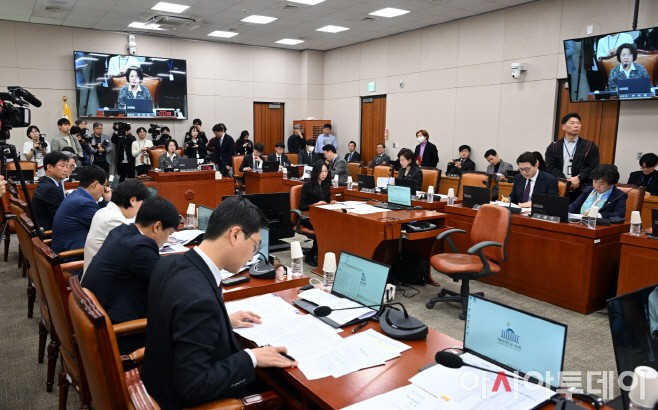 |
| A plenary session of the National Assembly’s Legislation and Judiciary Committee is held on Feb. 23. / Song Eui-joo |
The Democratic Party of Korea (DPK) pushed through a set of key reform bills, including a revision to the Commercial Act mandating the cancellation of treasury shares and amendments to the National Referendum Act, at the National Assembly’s Legislation and Judiciary Committee on Feb. 23, despite strong opposition from the People Power Party (PPP).
The bills cleared the committee stage with the support of the DPK and its allied lawmakers, who hold a majority. Six additional livelihood and reform-related bills, including revisions to the Labor Standards Act and the Occupational Safety and Health Act, were also approved.
The DPK has pledged to pass the reform measures within the February parliamentary session. Floor leader Han Byung-do said at a party leadership meeting, “If the processing of livelihood and reform bills is delayed, the damage falls entirely on the public. If the People Power Party does not cooperate, we will have no choice but to pass them unilaterally.”
Debate over the third revision to the Commercial Act remained heated. The DPK argued that mandating the cancellation of treasury shares would help support the KOSPI 5000 level and enhance shareholder value by increasing earnings per share (EPS). The PPP, however, warned that the measure could weaken companies’ defenses against hedge funds and heighten management risks.
The National Referendum Act revision also drew objections from the PPP, which claimed the review process was insufficient. Rep. Na Kyung-won protested that the bill had not been adequately discussed at the subcommittee level. Nevertheless, it passed with unanimous support from DPK members on the committee.
A proposed amendment to the Pardon Act, initially expected to be processed alongside the other bills, was put on hold after the Ministry of Justice requested additional time to submit detailed opinions. Justice Minister Jung Sung-ho previously stated that the president’s pardon authority is exercised within the framework set by law and that a legislative decision would not necessarily constitute a constitutional violation.
Attention now turns to whether the reform bills will be finalized at a plenary session scheduled for Feb. 24. The National Assembly Steering Committee approved a plan to convene plenary sessions from Feb. 24 through March 3 to handle the pending legislation.
The PPP, however, has called for a plenary session on Feb. 26 to process only mutually agreed livelihood bills. If the DPK proceeds with the Feb. 24 session as planned, the PPP is expected to respond with a filibuster in protest.
#Democratic Party of Korea #People Power Party #Commercial Act revision #mandatory treasury share cancellation #National Referendum Act
Copyright by Asiatoday
Most Read
-
1
Trump shares map on social media labeling Strait o..

-
2
Kia Sportage outperforms Mazda CX-5 in German auto..

-
3
Houthis launch successive attacks on Saudi airport..

-
4
U.S. deploys carrier, 10,000 more troops to Middle..

-
5
Trump rejects Iran's offer to open Strait of Hormu..

-
6
N. Korea conducts first swarm attack drill with dr..

-
7
U.S.-China summit falls short on substance as Trum..

PEOPLE






HEADLINE NEWS
- Seoul dismisses Ukraine's claim of 'S. Korean support for Russia' as "inaccurate and inappropriate"
- S. Korea, Japan race to develop nuclear-powered submarines
- Henri Kagan, Kenso Soai win Nobel Prize in Chemistry for uncovering how mol..
- Vance says Alaska LNG cooperation will move forward with Seoul's current or..

-
Address : In-Young Bldg., 34, Uisadang-daero 1-gil, Yeongdeungpo-gu, Seoul
Copyright by ASIATODAY CO., LTD. All rights resereved