



Kim Byung-gi makes cautious exit to limit fallout
Jan 20, 2026, 08:16 am


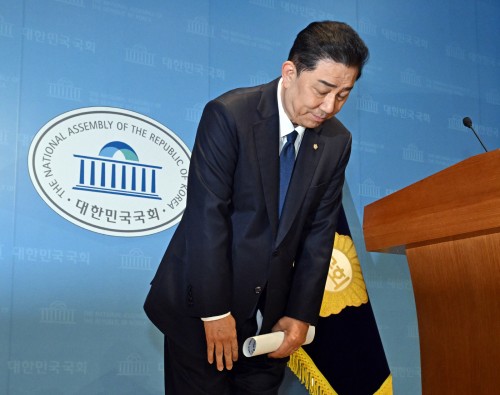 |
| Kim Byung-gi, a former floor leader of the Democratic Party of Korea, bows after delivering a statement on the party ethics panel’s expulsion decision at the National Assembly’s communications center on Jan. 19. / Photo by Song Eui-joo |
The decision by Kim Byung-gi to leave the Democratic Party of Korea on Monday is widely seen as a preemptive move to contain allegations at the individual level and prevent broader damage to the party. Rather than a full withdrawal from politics, the move has been interpreted as a “cautious exit,” leaving open the possibility of a future return.
Within the ruling camp, Kim’s voluntary departure prompted a mix of relief and concern. With local elections approaching, candidates’ personal images and ethical standards are under heightened scrutiny, particularly for regional and municipal posts where local media closely track individual records. In that context, allegations involving illegal political funds are considered especially damaging.
Kim has not been identified with either the pro–Lee Jae-myung or anti–Lee camps, and has instead been viewed as a figure aligned more by functional cooperation than factional loyalty. At a press briefing, he said he did not want to burden senior and fellow lawmakers by forcing a vote at a general caucus, asking that any expulsion be finalized by the party leadership rather than through a floor vote.
Under party rules, expelling a sitting lawmaker requires approval by a majority of all members at a caucus—an outcome that could have created a significant obstacle to any future political comeback. Observers noted that Kim lacked a strong internal bloc that might have shielded him during such proceedings.
Kim’s exit before formal action by the party is expected to ease the leadership’s decision-making burden and help contain the spread of allegations—14 in total, including suspected illegal political donations—beyond the individual. The move also blunts opposition attacks framing the case as a structural problem within the party, prompting assessments that the party chose the “lesser evil to prevent the worst.”
For the current leadership, the episode serves both as risk mitigation and as a constraint, setting an informal benchmark for when officials should step aside amid controversy. Analysts expect the party to toughen standards for handling money-related allegations and to strengthen candidate vetting ahead of local elections.
The party’s ethics committee voted on Jan. 12 to expel Kim over the allegations. Police investigations are accelerating, including a search conducted Monday by the Seoul Metropolitan Police Agency into claims that Kim’s spouse misused district council funds, as well as other accusations related to campaign financing and family matters.
#Kim Byung-gi #Democratic Party of Korea #voluntary resignation #party expulsion
Copyright by Asiatoday
Most Read
-
1
Trump shares map on social media labeling Strait o..

-
2
Kia Sportage outperforms Mazda CX-5 in German auto..

-
3
Houthis launch successive attacks on Saudi airport..

-
4
U.S. deploys carrier, 10,000 more troops to Middle..

-
5
Trump rejects Iran's offer to open Strait of Hormu..

-
6
N. Korea conducts first swarm attack drill with dr..

-
7
U.S.-China summit falls short on substance as Trum..

PEOPLE






HEADLINE NEWS
- Seoul dismisses Ukraine's claim of 'S. Korean support for Russia' as "inaccurate and inappropriate"
- S. Korea, Japan race to develop nuclear-powered submarines
- Henri Kagan, Kenso Soai win Nobel Prize in Chemistry for uncovering how mol..
- Vance says Alaska LNG cooperation will move forward with Seoul's current or..

-
Address : In-Young Bldg., 34, Uisadang-daero 1-gil, Yeongdeungpo-gu, Seoul
Copyright by ASIATODAY CO., LTD. All rights resereved