



Hyundai expands portfolio with AI and robotics drive
Jan 20, 2026, 08:16 am


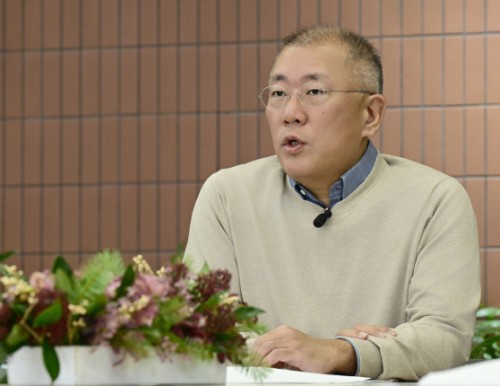 |
| Chung Eui-sun, chairman of Hyundai Motor Group, delivers a New Year message to employees at the group’s 2026 New Year gathering on Jan. 5. / Courtesy of Hyundai Motor Group |
Chairman Chung Eui-sun’s emphasis on “physical artificial intelligence (AI)” is emerging as a new business engine for Hyundai Motor Group, reinforcing a strategy to expand the conglomerate’s future portfolio across robotics and autonomous driving.
According to the Korea Exchange on Monday, Hyundai Motor’s market capitalization— including preferred shares—has surpassed 100 trillion won. The stock has risen about 60% since the start of the year, reflecting investor expectations following the group’s high-profile robotics and self-driving announcements at CES.
Hyundai shares had long been viewed as undervalued due to perceived gaps in autonomous-driving competitiveness. That view has shifted amid strengthened cooperation with Nvidia and the recruitment of top global talent from firms such as Tesla and Nvidia, boosting the company’s valuation.
At CES, Boston Dynamics unveiled its humanoid robot Atlas to global attention. Hyundai’s mobility robot platform “MobED” also won CES 2026’s Best of Innovation award in robotics, underscoring the group’s AI and robotics capabilities.
Hyundai showcased a groupwide robotics ecosystem spanning manufacturing, logistics, and mobility—ranging from the quadruped robot Spot to EV parking and charging robots. Boston Dynamics also announced a strategic partnership with DeepMind to accelerate next-generation humanoid development, outlining a concrete roadmap to lead human-centered “physical AI.”
Separately, Hyundai is deepening cooperation with Nvidia, including a contract to secure 50,000 Blackwell GPUs and initiatives following a prior agreement to enhance domestic physical AI capabilities. Plans include establishing an Nvidia AI technology center in Korea and building an “AI data center” ecosystem to advance in-vehicle AI, autonomous driving, manufacturing efficiency, and robotics.
Industry observers say the strategy positions Hyundai to turn robotics and autonomous driving into new revenue streams—moving beyond R&D toward services such as robot-enabled solutions and commercial robotaxi operations.
“U.S. and Chinese humanoid firms may currently be ahead, but Hyundai’s strategy—pairing AI brains with mobility—stands out,” one industry source said. “With strengths in mass production and quality control, Hyundai is well placed to become a humanoid partner for the U.S. and Western markets.”
#Chung Eui-sun #Hyundai Motor Group #physical AI #robotics #autonomous driving
Copyright by Asiatoday
Most Read
-
1
Kia Sportage outperforms Mazda CX-5 in German auto..

-
2
Houthis launch successive attacks on Saudi airport..

-
3
Saudi Arabia, Iran hold first diplomatic talks to..

-
4
U.S. deploys carrier, 10,000 more troops to Middle..

-
5
Saudi airport in Riyadh struck again, leaving at l..

-
6
Putin's ally visits China on the 8th ahead of APEC..

-
7
Chinese military support and training center opens..

PEOPLE






HEADLINE NEWS

-
Address : In-Young Bldg., 34, Uisadang-daero 1-gil, Yeongdeungpo-gu, Seoul
Copyright by ASIATODAY CO., LTD. All rights resereved