



US tariff pressure puts Korean chips on edge
Jan 19, 2026, 07:53 am


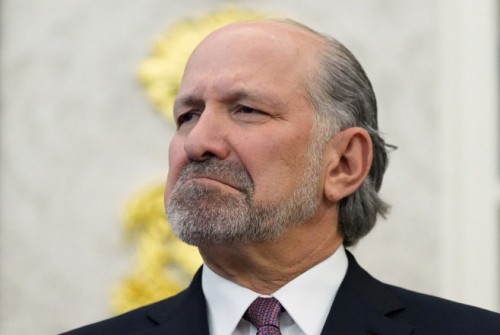 |
| U.S. Commerce Secretary Howard Lutnick attends an event hosted by President Donald Trump at the White House on Jan. 14. / AP-Yonhap |
The administration of Donald Trump has placed South Korea’s semiconductor industry at a critical crossroads by redefining chips as a “core national security asset” rather than a simple export item and positioning tariffs as a central tool of industrial policy.
Washington has reaffirmed that semiconductor tariffs—and any exemptions—will be determined through country-by-country negotiations. As a result, South Korea will not automatically receive the same exemption standards applied to Taiwan and is now entering separate talks under mounting U.S. investment pressure and a potentially steep “bill.”
Howard Lutnick said that memory semiconductors—an area of strength for Korean firms—would face a 100 percent tariff if they are not produced in the United States. He made the remarks after attending a groundbreaking ceremony for a new chip plant by Micron near Syracuse, New York, according to a Jan. 16 report by Bloomberg.
Bloomberg noted that potential tariffs tied to the U.S.-Taiwan agreement could also affect Korean chipmakers, adding that it remains unclear how much more Samsung Electronics and SK hynix would be willing to spend beyond their existing investment commitments.
Earlier, the Trump administration finalized a trade agreement with Taiwan on Jan. 15, establishing a model in which tariff relief or exemptions are linked directly to investment pledges. The issue now centers on South Korea. A senior U.S. official said on Jan. 16, in response to a question from Korean media about whether Taiwan’s exemption standards would apply to Korea, that “separate agreements will be made with each country.”
The comment has been interpreted to mean that South Korea must independently prove its level of contribution at the negotiating table to receive similar treatment. With Taiwan pledging investments totaling $250 billion, Korean firms could face demands for comparable—or even greater—commitments.
Meanwhile, the presidential office in Seoul said it would engage in consultations with Washington “in line with the principle of non-discriminatory treatment,” as stated in the joint U.S.-Korea fact sheet, to minimize the impact of the U.S. semiconductor tariff proclamation on Korean companies.
#US tariffs #semiconductors #national security #Korea chipmakers #Samsung Electronics
Copyright by Asiatoday
Most Read
-
1
Trump shares map on social media labeling Strait o..

-
2
Kia Sportage outperforms Mazda CX-5 in German auto..

-
3
Houthis launch successive attacks on Saudi airport..

-
4
U.S. deploys carrier, 10,000 more troops to Middle..

-
5
Trump rejects Iran's offer to open Strait of Hormu..

-
6
N. Korea conducts first swarm attack drill with dr..

-
7
U.S.-China summit falls short on substance as Trum..

PEOPLE





HEADLINE NEWS
- Seoul dismisses Ukraine's claim of 'S. Korean support for Russia' as "inaccurate and inappropriate"
- S. Korea, Japan race to develop nuclear-powered submarines
- Henri Kagan, Kenso Soai win Nobel Prize in Chemistry for uncovering how mol..
- Vance says Alaska LNG cooperation will move forward with Seoul's current or..

-
Address : In-Young Bldg., 34, Uisadang-daero 1-gil, Yeongdeungpo-gu, Seoul
Copyright by ASIATODAY CO., LTD. All rights resereved