



One person, one vote push stirs ruling party rift
Jan 19, 2026, 07:53 am


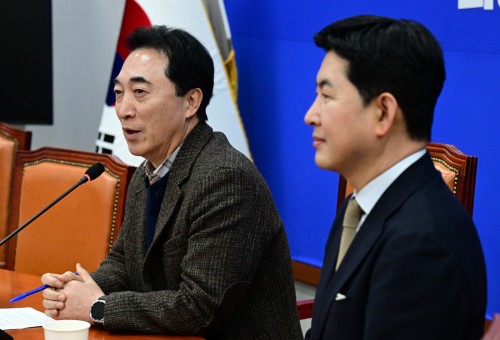 |
| Park Soo-hyun, senior spokesperson of the Democratic Party of Korea, speaks at a press briefing at the National Assembly on Jan. 18. Park said he had “never even heard the first consonant of the word ‘reelection’” from party leader Chung Cheong-rae, rejecting claims that the rule change is aimed at securing Chung’s second term. / Photo by Lee Byung-hwa |
The ruling Democratic Party of Korea has reignited internal controversy after party leader Chung Cheong-rae moved to revive the “one person, one vote” system, under which delegates and rank-and-file party members would have equal voting power.
While the leadership frames the move as a measure to strengthen party members’ sovereignty, critics within the party argue it could amount to a “self-serving rule change” designed to favor Chung’s potential bid for a second term ahead of the party convention scheduled for August.
According to political sources on Sunday, the party’s Supreme Council recently approved, in a closed-door meeting, a revision to party rules that would apply a 1-to-1 voting ratio between delegates and registered party members in the election of the party leader and supreme council members.
The core of the revision is the elimination of the weighted value of delegates’ votes, which had previously been worth nearly 20 times that of ordinary party members.
The proposal had failed to pass the Central Committee last December. This time, however, it was reintroduced with a compromise measure that allocates one of two party leader–appointed supreme council seats to figures from strategic regions such as Yeongnam.
Even within the leadership, concerns have surfaced over both timing and procedure. Supreme Council member Lee Eon-ju reportedly said the issue should be handled by the next party convention preparation committee, arguing that such changes would be more appropriate at that stage.
Another supreme council member, Kang Deuk-gu, who is considered close to Prime Minister Kim Min-seok, was also quoted as warning of a potential conflict of interest if the new system were applied immediately to the next party convention while speculation about Chung’s reelection bid persists. Fellow member Hwang Myung-sun reportedly echoed the concern, saying public sentiment should not be ignored.
Within the party, critics argue that the revision would amplify the influence of Chung’s core support base—hardline party members—and effectively lock in his reelection at the August convention. They contend that while the plan is presented as a general reform, it ultimately changes the rules midterm in a way that benefits the incumbent.
Chung, however, pushed back strongly during the meeting, reportedly saying, “How would anyone know whether I will run in the next convention or not?” He compared the criticism to accusing former presidents Kim Young-sam and Kim Dae-jung of advocating direct presidential elections in 1987 merely to help themselves run for office.
Lawmaker Moon Jeong-bok was also quoted as saying it was “absurd” to base objections on hypothetical scenarios, adding that reopening objections to an issue already discussed was inappropriate.
Meanwhile, senior spokesperson Park Soo-hyun sought to play down reports of internal strife, telling reporters that while there were supplementary opinions aimed at improving the proposal, the decision was ultimately made unanimously.
Addressing claims that the move was intended to secure Chung’s reelection, Park said, “I have never heard even the consonant ‘r’ of the word ‘reelection’ from the leader,” adding that assuming one million party members would blindly support Chung was “an insult to the collective intelligence of party members.”
Park stressed that the one person, one vote system is a key pledge of Chung’s leadership and reflects the party’s “spirit of the times,” arguing that labeling it a reelection ploy was inappropriate.
The Democratic Party plans to hold a party affairs committee meeting on Jan. 19, conduct a three-day vote of all party members starting Jan. 22, and finalize the rule revision at a Central Committee meeting on Feb. 3.
#Democratic Party of Korea #one person one vote #party rules revision #Chung Cheong-rae #party leadership race
Copyright by Asiatoday
Most Read
-
1
Trump shares map on social media labeling Strait o..

-
2
Kia Sportage outperforms Mazda CX-5 in German auto..

-
3
Houthis launch successive attacks on Saudi airport..

-
4
U.S. deploys carrier, 10,000 more troops to Middle..

-
5
Trump rejects Iran's offer to open Strait of Hormu..

-
6
N. Korea conducts first swarm attack drill with dr..

-
7
U.S.-China summit falls short on substance as Trum..

PEOPLE





HEADLINE NEWS
- Seoul dismisses Ukraine's claim of 'S. Korean support for Russia' as "inaccurate and inappropriate"
- S. Korea, Japan race to develop nuclear-powered submarines
- Henri Kagan, Kenso Soai win Nobel Prize in Chemistry for uncovering how mol..
- Vance says Alaska LNG cooperation will move forward with Seoul's current or..

-
Address : In-Young Bldg., 34, Uisadang-daero 1-gil, Yeongdeungpo-gu, Seoul
Copyright by ASIATODAY CO., LTD. All rights resereved