



KOSPI nears 5,000 as accounts near 100 million
Jan 19, 2026, 07:53 am


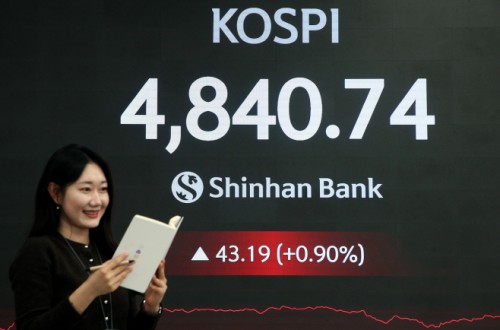 |
| Status board at Shinhan Bank headquarters in Jung-gu, Seoul, on Jan. 16. / Shinhan Bank |
As the KOSPI edges closer to the 5,000 mark, the number of active stock trading accounts in South Korea is also approaching a historic milestone, with 100 million accounts likely to be reached as early as early February.
According to the Korea Financial Investment Association, the number of active stock trading accounts stood at 99,004,613 as of Jan. 15, leaving fewer than one million accounts to reach the 100 million threshold. Compared with the end of last year, when the total was 98,291,148, more than 713,000 new active accounts were added in just the first half of January.
An “active” stock trading account refers to a brokerage or securities savings account that has recorded at least one trade in the past six months and maintains a balance of at least 100,000 won.
The pace of account growth has accelerated significantly this year. While the daily average increase last year was about 32,000 accounts, the figure has surged to roughly 47,500 per day so far this year—an increase of around 1.5 times.
If this trend continues, market observers expect the number of active accounts to surpass 100 million between the first and second weeks of February. Even if the pace slows back to last year’s level, the milestone is still expected to be reached by mid- to late February.
The sharp rise in account openings reflects investors’ eagerness to participate in a historic market rally. With headlines highlighting the KOSPI’s approach toward 5,000, so-called FOMO (fear of missing out) sentiment has intensified, drawing new investors into the market.
According to the Korea Exchange, the KOSPI closed at 4,840.74 on Jan. 16, up 0.90 percent from the previous session. Since the start of the year, the index has recorded gains for 11 consecutive trading days without a single decline, marking the third-longest winning streak on record after September 2019 and March–April 2006.
However, the rapid influx of investors has also raised concerns. Market analysts warn that inexperienced retail investors could face significant losses if a correction occurs after such a sharp run-up.
Kim Jong-min, an analyst at Samsung Securities, said, “The absence of clear negative factors that could stop this rally is, paradoxically, the biggest risk,” adding that the market may need to slow down to account for the possibility of a short-term technical correction.
Analysts at Daishin Securities echoed the caution, noting that while upward revisions to earnings forecasts have kept KOSPI valuations from becoming overly burdensome, sector rotation has been occurring rapidly. They advised investors to focus on selectively identifying undervalued stocks rather than chasing prices higher.
#KOSPI #stock trading accounts #one hundred million accounts #retail investors #FOMO
Copyright by Asiatoday
Most Read
-
1
Celltrion’s Omlyclo gains ground in major European..

-
2
Trump demands rates fall below 1% as Fed hikes for..

-
3
Trump makes $1 trillion bet ahead of midterm elect..

-
4
Iran resumes ballistic missile production, assembl..

-
5
Trump warns countries not helping U.S. must pay re..

-
6
Apple launches first foldable, 1 million won prici..

-
7
Turkish Airlines named main club partner of Liverp..

PEOPLE







-
Address : In-Young Bldg., 34, Uisadang-daero 1-gil, Yeongdeungpo-gu, Seoul
Copyright by ASIATODAY CO., LTD. All rights resereved