



Seoul declares abolition of prosecutors’ follow-up probe power
Jan 15, 2026, 07:57 am


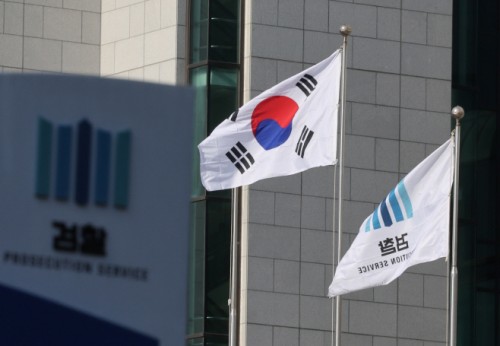 |
| The Supreme Prosecutors’ Office in Seocho District, Seoul, is seen on Jan. 14. / Yonhap |
The government has decided to abolish prosecutors’ supplementary investigation powers even before formal discussions begin within its prosecution reform task force, drawing criticism that a declaration has preceded deliberation.
Although a government bill to dismantle the prosecution service and establish a Major Crimes Investigation Office and a Public Prosecution Office has entered the legislative notice period, the fate of prosecutors’ supplementary investigation authority—one of the most contentious issues—has yet to be discussed internally. Still, Prime Minister Kim Min-seok has declared that “abolition is the principle,” effectively setting the direction in advance.
According to sources on Jan. 14, the prosecution reform task force under the Prime Minister’s Office has not started internal deliberations on whether to retain supplementary investigation powers for prosecutors at the Public Prosecution Office, despite calls from the ruling bloc to keep them. Instead, officials prioritized drafting bills related to launching the new agencies, leaving revisions to the Criminal Procedure Act—required to address supplementary investigation powers—as a matter for later discussion.
Supplementary investigation authority allows prosecutors to directly investigate shortcomings in cases transferred by police, unlike the more limited power to request additional police investigation. Because it permits direct investigative action, it carries a different weight.
The issue has sharply divided political and legal circles. Advocates of full abolition argue that allowing prosecutors to retain the authority would enable them to conduct direct investigations under the guise of follow-up work. Opponents counter that the power is essential to prevent cases from being buried and to provide a check on primary investigative agencies.
The Ministry of Justice, which would oversee the new Public Prosecution Office, has shown a more cautious stance than some in the ruling camp. Justice Minister Jung Sung-ho said on his way to work at the Gwacheon Government Complex that while the government bill was crafted after extensive review, it still requires careful parliamentary debate. On supplementary investigations, he said the ministry would take time to examine potential problems before drafting amendments to the Criminal Procedure Act—signaling openness to discussion rather than a definitive abolition.
Last month, the ministry published a collection of 77 cases highlighting instances in which prosecutors clarified facts through supplementary investigations, including cases on the verge of being shelved. In the foreword, Jung noted that police investigations cannot be guaranteed to be flawless and warned that anyone could become an unjust victim.
A former prosecutor-turned-lawyer said prosecutors tasked with deciding whether to indict must have the minimum authority to assess investigative completeness. “If incomplete primary investigations proceed to trial, the consequences fall not on investigators but on the public,” he said, arguing that supplementary investigation powers serve as a crucial safeguard.
#prosecution reform #supplementary investigation power #Ministry of Justice #Major Crimes Investigation Office
Copyright by Asiatoday
Most Read
-
1
Celltrion nears additional contract with major U.S..

-
2
Putin proposes trilateral U.S.-China-Russia summit..

-
3
U.S. weighs dropping MOAB, world's most powerful n..

-
4
"Aren't those foreigners on welfare?": M..

-
5
Attention centers on APEC for possible Trump-Xi-Pu..

-
6
Saudi Arabia, Iran hold first diplomatic talks to..

-
7
U.S., Israel plan to resume strikes on Iran after..

PEOPLE







-
Address : In-Young Bldg., 34, Uisadang-daero 1-gil, Yeongdeungpo-gu, Seoul
Copyright by ASIATODAY CO., LTD. All rights resereved