



After 32-hour hearing, only verdict remains for Yoon
Jan 15, 2026, 07:57 am


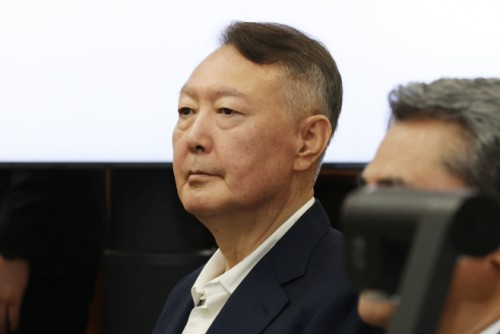 |
| Former President Yoon Suk Yeol attends his first court hearing following his indictment by a special counsel. / Yonhap |
After an unprecedented 32-hour closing hearing, former President Yoon Suk Yeol now awaits only the first-instance verdict, having faced a request for the maximum statutory penalty—death—for allegedly leading an insurrection.
It is the first time in 30 years that prosecutors have sought the death penalty against a former president, since August 1996, when it was requested for former President Chun Doo-hwan. Given that South Korea is widely regarded as a de facto abolitionist state, life imprisonment is considered the most likely sentence.
Legal analysts note that while the element of “intent to undermine the constitutional order” appears relatively clear, there remains room for debate over whether the acts in question constitute “violent uprising,” another core requirement of the crime of insurrection. The absence of casualties also distinguishes the case from past military coups. However, critics argue this should not be treated as a mitigating factor, as the Constitutional Court previously found that the early lifting of martial law resulted from public resistance and passive responses by military and police forces.
The special counsel team led by Cho Eun-seok sought the death penalty during the closing hearing held on Jan. 13 at the Seoul Central District Court. Prosecutors characterized the Dec. 3 declaration of martial law as a “grave constitutional destruction by anti-state forces,” stressing that harsher punishment than that imposed on the former military junta was necessary to prevent a tragic repetition of history. They argued that the declaration—the first in 45 years—was driven by ambitions of authoritarian rule and prolonged power.
Under South Korean law, insurrection requires both an intent to subvert the constitutional order and the use of violence. The key legal questions are whether Yoon sought to disable the National Assembly’s constitutional functions through martial law and whether the deployment of troops amounted to violence or intimidation sufficient to disrupt public order.
Past precedents loom large. Although prosecutors sought the death penalty for Chun Doo-hwan, the Supreme Court ultimately sentenced him to life imprisonment, citing factors such as the June 29 Declaration that paved the way for democratic recovery and his status as a former president. In Chun’s case, the military blockade of the National Assembly and the nationwide expansion of martial law were recognized as acts of insurrection.
Many in legal circles believe that Yoon’s Dec. 3 martial law declaration could similarly satisfy the requirement of intent to undermine the constitutional order, particularly in terms of paralyzing the legislature.
Han Sang-hee, professor emeritus at Konkuk University Law School, said, “The very act of issuing a proclamation restricting the National Assembly, the National Election Commission and citizens’ political activities clearly constitutes an attempt to undermine the constitutional order,” adding that life imprisonment is the most probable outcome given how rarely courts impose the death penalty.
Jang Young-soo, professor emeritus at Korea University Law School, said if allegations that Yoon ordered the arrest of the National Assembly speaker and party leaders are confirmed, it would demonstrate an intent to neutralize the legislature entirely. Still, he argued that compared with past coups, the declaration involved far less force, caused virtually no casualties or property damage, and was lifted within hours—factors that could lead to mitigation.
Han disagreed, urging a broader interpretation of insurrection in a highly democratized society. “Choosing a military mobilization system such as martial law itself constitutes an uprising,” he said, adding that the lack of casualties was due to civic resistance and restrained enforcement, not the defendant’s intent. He stressed that reports of a possible second declaration suggest sustained intent, arguing that the swift end of martial law should not reduce the sentence.
Legal experts also dismissed Yoon’s claim that the declaration was a “warning” to the public. Jang said the argument was meaningless given that the Constitutional Court had already ruled the declaration unconstitutional in its impeachment decision. Han criticized the defense for focusing on procedural flaws, saying they failed to provide a rational explanation or evidence for why martial law was declared and why the legislature was blocked.
#Yoon Suk Yeol #insurrection charge #death penalty #life imprisonment #special counsel
Copyright by Asiatoday
Most Read
-
1
Celltrion nears additional contract with major U.S..

-
2
Putin proposes trilateral U.S.-China-Russia summit..

-
3
U.S. weighs dropping MOAB, world's most powerful n..

-
4
"Aren't those foreigners on welfare?": M..

-
5
Attention centers on APEC for possible Trump-Xi-Pu..

-
6
Saudi Arabia, Iran hold first diplomatic talks to..

-
7
U.S., Israel plan to resume strikes on Iran after..

PEOPLE







-
Address : In-Young Bldg., 34, Uisadang-daero 1-gil, Yeongdeungpo-gu, Seoul
Copyright by ASIATODAY CO., LTD. All rights resereved