



Super ministry concerns grow over MOIS authority
Jan 14, 2026, 08:05 am


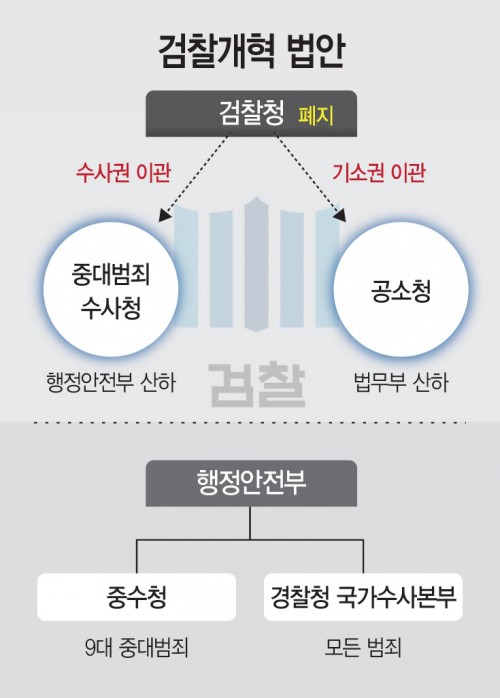 |
Concerns are mounting that the Ministry of the Interior and Safety is becoming an all-powerful “super ministry,” raising fears that political neutrality in criminal investigations could be undermined as its authority expands.
Under prosecutorial reform bills unveiled on Jan. 12 by the Prosecutorial Reform Task Force, the MOIS minister would hold supervisory authority over the newly proposed Serious Crimes Investigation Agency, in addition to overseeing the police. While the minister would generally direct and supervise the agency’s administrative affairs, guidance on specific cases would, in principle, be limited to the agency chief.
The task force said ministerial intervention in investigations would be restricted to exceptional circumstances, allowing case-specific oversight only when “serious and clear illegal acts” are identified. The provision is intended to safeguard investigative independence.
Still, critics argue that placing both the police and the new agency under the MOIS—while also granting the minister exceptional authority over individual cases—could invite abuse of power. Some legal experts say the Ministry of Justice, which retains prosecutorial authority, should be able to provide checks on the MOIS.
Others point to the vagueness of the phrase “serious and clear illegal acts,” warning that unclear standards could open the door to arbitrary judgments by the minister and undue interference in investigations.
President Lee Jae-myung underscored the issue last month, instructing the Ministry of Government Legislation to clearly codify the legal basis for ministerial oversight of police investigations. At a Cabinet meeting on Dec. 30, he questioned the lack of control over the head of the National Investigation Headquarters, noting that prosecutors are subject to ministerial direction while police investigations have lacked comparable oversight.
The task force maintains that oversight is necessary given the sweeping investigative powers the new agency would wield. Yet critics counter that this approach only further concentrates authority in the MOIS, whose portfolio already includes disaster and safety management, the National Fire Agency, and the National Police Agency.
Legal circles are calling for institutional safeguards to prevent excessive concentration of power. Even within the task force, internal disagreements reportedly surfaced during the drafting process over the scope of ministerial control. Vice Director Noh Hye-won said discussions are ongoing about how to reorganize internal structures and install minimum checks on personnel and major crime oversight.
A former prosecutor-turned-attorney warned that two “unchecked investigative giants” under the MOIS could emerge. “There is growing criticism that the ministry could become an uncontrollable monster due to the expansion of ministerial authority,” he said, urging the government to refine the legislation by incorporating a broad range of expert and inter-agency opinions.
#Ministry of the Interior and Safety #political neutrality #investigative authority
Copyright by Asiatoday
Most Read
-
1
Celltrion’s Omlyclo gains ground in major European..

-
2
Trump demands rates fall below 1% as Fed hikes for..

-
3
Hyundai Motor Group breaks ground on integrated st..

-
4
U.S. strikes 3 Iranian oil tankers, Iran vows reta..

-
5
Trump makes $1 trillion bet ahead of midterm elect..

-
6
Iran resumes ballistic missile production, assembl..

-
7
Samsung Electronics, Mistral AI to jointly develop..

PEOPLE







-
Address : In-Young Bldg., 34, Uisadang-daero 1-gil, Yeongdeungpo-gu, Seoul
Copyright by ASIATODAY CO., LTD. All rights resereved