



Bus walkout drags on as talks stall
Jan 14, 2026, 08:05 am


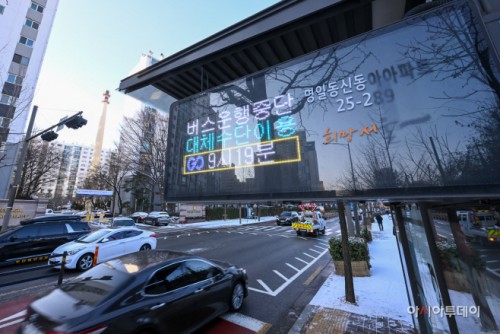 |
| A notice announcing suspended bus services is displayed at a bus stop in Myeongil-dong, Gangdong District, Seoul, on the morning of Jan. 13, as the Seoul city bus union begins an indefinite full strike. / Photo by Jung Jae-hoon |
Concerns are growing that the Seoul city bus strike could drag on, as labor and management remain far apart and have yet to set a timetable for additional negotiations.
City buses in Seoul halted operations indefinitely on Jan. 13 after wage talks collapsed overnight. With positions sharply divided and no follow-up talks scheduled, a swift return to normal service appears unlikely.
Kim Jeong-hwan, chairman of the Seoul Bus Transport Association, said at a City Hall briefing that management had proposed a 10.3% pay increase based on a 209-hour calculation for ordinary wages, with a pledge to retroactively pay any difference should the Supreme Court later adopt the union’s preferred 176-hour standard. “The union rejected the offer,” he said.
Kim added that the union is demanding a raise of more than 16% by applying the 176-hour standard, calling the request “excessive,” noting the lack of precedent in other regions and the absence of a court ruling.
According to the Seoul Metropolitan Government, final talks between labor and management broke down around 1:30 a.m. after a special mediation session at the Seoul Regional Labor Relations Commission that began at 3 p.m. the previous day. Failing to bridge differences even after midnight, the union launched a full strike from 4 a.m. as planned.
This marks the first full stoppage of Seoul city buses in nearly two years, since March 28, 2024, when a strike ended within 11 hours and service resumed the same day. The union has said that if a late-night agreement is reached, buses could return to service starting with the first runs on Jan. 14.
As of 9 a.m. on Jan. 13, only 478 of the city’s 7,018 buses—about 6.8%—were operating. Management said no additional talks have been scheduled, signaling the possibility of a prolonged strike. A city official said everything remains uncertain, including what demands the union may bring and when negotiations might resume.
If the strike continues, officials warn of mounting inconvenience for residents and rising fiscal pressure. Seoul spends roughly 5 trillion won annually on its semi-public bus system, with cumulative deficits pushing the total burden to an estimated 8 trillion won. The city estimates that a wage hike exceeding 10% could add more than 1 trillion won in annual costs, while emergency transport measures alone cost about 10 billion won per day.
Mayor Oh visited the disaster safety situation room at 6:50 a.m. to review emergency measures. Subway services were increased by 172 runs per day, and last trains were extended to 2 a.m. the following day at terminal stations. Subway ridership between 5 a.m. and 7 a.m. rose about 18% from the same period a day earlier.
All 25 district governments also rolled out stopgap transport plans. Districts including Yongsan, Yeongdeungpo and Gangdong deployed chartered buses on temporary routes linking residential areas to subway stations, while others operated free shuttle services to minimize gaps.
Oh said the city would “continue persuading both sides until buses—the backbone of daily mobility—return to normal service as soon as possible.”
#Seoul city bus strike #labor-management talks #wage negotiations #emergency transport measures #subway service increase
Copyright by Asiatoday
Most Read
-
1
Celltrion’s Omlyclo gains ground in major European..

-
2
Trump demands rates fall below 1% as Fed hikes for..

-
3
Hyundai Motor Group breaks ground on integrated st..

-
4
U.S. strikes 3 Iranian oil tankers, Iran vows reta..

-
5
Trump makes $1 trillion bet ahead of midterm elect..

-
6
Iran resumes ballistic missile production, assembl..

-
7
Samsung Electronics, Mistral AI to jointly develop..

PEOPLE






-
Address : In-Young Bldg., 34, Uisadang-daero 1-gil, Yeongdeungpo-gu, Seoul
Copyright by ASIATODAY CO., LTD. All rights resereved