



People Power Party–Reform Party unite on special prosecutors, deny vote tie-up
Jan 14, 2026, 08:05 am


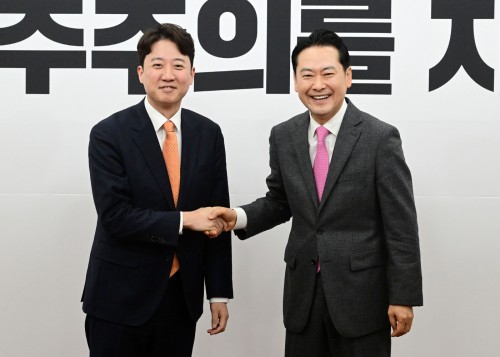 |
| People Power Party leader Jang Dong-hyeok (right) and Reform Party leader Lee Jun-seok shake hands during a meeting on a “special prosecutor alliance on nomination bribery and the Unification Church” at the National Assembly in Yeouido, Seoul, on Jan. 13. / Photo by Lee Byung-hwa |
The “special prosecutor alliance” between the People Power Party and the Reform Party is taking shape as the two sides join forces to pressure the ruling camp. Observers, however, say it is too early to view the move as an electoral alliance ahead of the June 3 local elections, as both parties draw a clear line against expanding the cooperation.
The two parties agreed to coordinate on special prosecutor probes into alleged nomination bribery, suspected collusion between the Unification Church and political authorities, and alleged external pressure on prosecutors to drop an appeal in the Daejang-dong development case. They also signaled plans to jointly introduce a special prosecutor bill targeting Democratic Party lawmakers Kim Byung-ki and Kang Sun-woo over the nomination bribery allegations.
People Power Party leader Jang Dong-hyeok and Reform Party leader Lee Jun-seok met at the National Assembly on Jan. 13 and formally confirmed their intent to cooperate. While the parties’ floor leaders had agreed last month to jointly sponsor a Unification Church special prosecutor bill, this marked the first time the party chiefs publicly affirmed coordination.
Despite Lee’s overtures, Cho Kuk Innovation Party leader Cho Kuk did not attend the meeting. Cho rejected Lee’s proposal, saying it was inappropriate to offer the People Power Party an “escape route,” and later criticized repeated approaches as “lacking courtesy.” As a result, the opposition-side special prosecutor cooperation is expected to continue without the Cho Kuk Innovation Party for now.
The People Power Party and the Reform Party appear to be narrowing differences on key issues such as who would recommend special prosecutors and the scope of investigations. On the Unification Church bill, the People Power Party had favored granting the recommendation authority to legal experts such as the chief justice, while the Reform Party argued that a third party without ties to the church should hold that power. As follow-up discussions to last month’s joint bill, the two sides are expected to seek common ground around a proposal under which the head of the National Court Administration would recommend candidates.
Some in political circles speculate that the cooperation could open the door to a broader local-election alliance, noting that the two conservative-leaning parties—often at odds over major issues including former President Yoon Suk Yeol’s declaration of martial law—have found rare common cause just five months before the vote. Jang’s public apology over the martial law controversy on Jan. 7, delivered while wearing an orange tie symbolizing the Reform Party and referencing “broad political cooperation,” has further fueled such interpretations.
Both sides, however, downplayed any prospect of an electoral pact. The Reform Party has consistently denied the possibility of an election alliance, and the People Power Party also declined to elaborate when asked whether local-election cooperation was discussed, saying the meeting focused on current issues. Analysts say the gap between the parties’ positions remains wide, making formal electoral coordination difficult for now.
#special prosecutor alliance #People Power Party #Reform Party
Copyright by Asiatoday
Most Read
-
1
Trump shares map on social media labeling Strait o..

-
2
Kia Sportage outperforms Mazda CX-5 in German auto..

-
3
Houthis launch successive attacks on Saudi airport..

-
4
U.S. deploys carrier, 10,000 more troops to Middle..

-
5
Trump rejects Iran's offer to open Strait of Hormu..

-
6
N. Korea conducts first swarm attack drill with dr..

-
7
U.S.-China summit falls short on substance as Trum..

PEOPLE





HEADLINE NEWS
- Seoul dismisses Ukraine's claim of 'S. Korean support for Russia' as "inaccurate and inappropriate"
- S. Korea, Japan race to develop nuclear-powered submarines
- Henri Kagan, Kenso Soai win Nobel Prize in Chemistry for uncovering how mol..
- Vance says Alaska LNG cooperation will move forward with Seoul's current or..

-
Address : In-Young Bldg., 34, Uisadang-daero 1-gil, Yeongdeungpo-gu, Seoul
Copyright by ASIATODAY CO., LTD. All rights resereved