



People Power Party faces candidate drought outside TK
Jan 06, 2026, 08:38 am


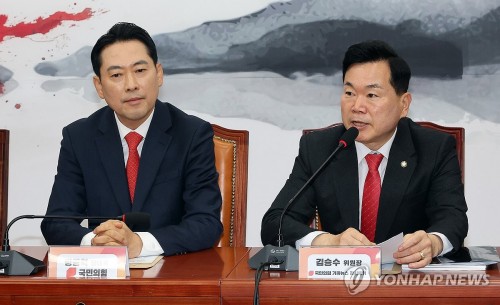 |
| Kim Seung-soo, chair of the People Power Party’s special committee on alleged opposition suppression and fake news, delivers remarks during an appointment ceremony and the committee’s first plenary meeting at the National Assembly on Jan. 5. / Yonhap |
The ruling People Power Party is grappling with a growing shortage of viable candidates ahead of the June 3 local elections, as competition intensifies in its traditional stronghold of Daegu and North Gyeongsang Province while the capital region and central provinces remain largely devoid of prominent challengers.
According to political sources on Sunday, concerns are mounting within the party as incumbent governors and mayors in the Seoul metropolitan area and the Chungcheong region have been underperforming in major opinion polls early this year, raising fears about electoral competitiveness in key battlegrounds.
In contrast, the Daegu–North Gyeongsang (TK) region has seen a surge of potential contenders, where securing the party’s nomination is widely viewed as tantamount to winning the election. “There is no shortage of hopefuls in TK, but in the capital region and Chungcheong, there are no candidates with strong name recognition,” a party official said. “There is growing concern that even the nomination process could lack momentum.”
In Daegu, fierce competition is expected for the mayoral race, with National Assembly Vice Speaker Joo Ho-young and former floor leaders Yoon Jae-ok and Choo Kyung-ho among those mentioned as potential contenders. The North Gyeongsang governorship is also shaping up to be highly competitive, as incumbent Governor Lee Cheol-woo has declared his bid for a third term, while senior party figures are expanding their political activities.
The atmosphere is markedly different in the Seoul metropolitan area. In Seoul, only incumbent Mayor Oh Se-hoon and lawmaker Na Kyung-won have openly signaled interest. In Gyeonggi Province, possible bids by Ahn Cheol-soo and Kim Eun-hye have been discussed but are widely seen as unlikely to materialize, while former lawmaker Yoo Seung-min has effectively ruled himself out. In Incheon, aside from incumbent Mayor Yoo Jeong-bok and speculation surrounding a potential challenger, intra-party competition remains muted.
The uneven regional landscape has fueled internal debate over the party’s electoral strategy. While some members argue for maintaining a core-supporter-focused approach, others contend that expanding the party’s appeal beyond its traditional base is essential to winning contests in the capital region and other swing areas.
#People Power Party #local elections #candidate shortage #TK region #party nomination
Copyright by Asiatoday
Most Read
-
1
Trump shares map on social media labeling Strait o..

-
2
Kia Sportage outperforms Mazda CX-5 in German auto..

-
3
Houthis launch successive attacks on Saudi airport..

-
4
U.S. deploys carrier, 10,000 more troops to Middle..

-
5
Trump rejects Iran's offer to open Strait of Hormu..

-
6
N. Korea conducts first swarm attack drill with dr..

-
7
U.S.-China summit falls short on substance as Trum..

PEOPLE





HEADLINE NEWS
- Seoul dismisses Ukraine's claim of 'S. Korean support for Russia' as "inaccurate and inappropriate"
- S. Korea, Japan race to develop nuclear-powered submarines
- Henri Kagan, Kenso Soai win Nobel Prize in Chemistry for uncovering how mol..
- Vance says Alaska LNG cooperation will move forward with Seoul's current or..

-
Address : In-Young Bldg., 34, Uisadang-daero 1-gil, Yeongdeungpo-gu, Seoul
Copyright by ASIATODAY CO., LTD. All rights resereved