



KOSPI hits record high as year begins
Jan 05, 2026, 07:24 am


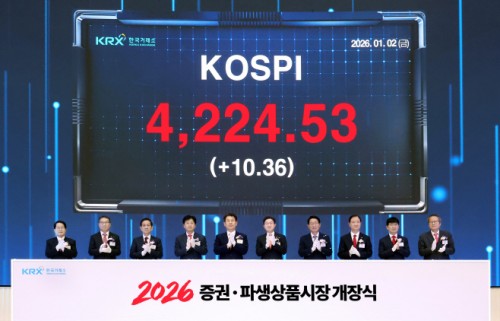 |
| The KOSPI index is displayed on an electronic board at the Korea Exchange in Yeouido, Seoul, during the opening ceremony of the 2026 securities and derivatives markets on Jan. 2. / Korea Exchange |
South Korea’s benchmark stock index surged to an all-time high on the first trading day of the new year, raising questions over whether the so-called “January effect” will hold again in 2026.
Market attention is focused on whether the momentum that drove the market to a gain of more than 75 percent last year can be sustained, supported by a semiconductor rally and expectations tied to artificial intelligence.
According to the Korea Exchange, the KOSPI closed at 4,309.63 on Jan. 2, up 95.46 points, or 2.27 percent, from the previous session. During intraday trading, the index climbed as high as 4,301.18, breaking above the 4,300 mark and surpassing its previous intraday record of 4,226.75 set two months earlier.
Traditionally, market performance at the start of the year is viewed as a barometer for the broader annual trend. Data show that sectors posting gains in January go on to maintain strength throughout the year with a probability of around 60 percent, heightening investor focus on early-year market moves.
Brokerage houses expect the semiconductor sector, which led last year’s rally, to remain a key driver in 2026. Over the course of 2025, semiconductor stocks soared 159 percent, far outpacing the KOSPI’s annual gain of 75.6 percent. Excluding semiconductors, the benchmark’s rise would have been limited to about 46 percent, underscoring the sector’s dominant role.
The recent surge is being widely interpreted through the lens of the “January effect,” a seasonal phenomenon in which stock markets tend to deliver higher returns in the first month of the year, often showing a degree of correlation with annual performance. The pattern is typically attributed to the reinvestment of funds following year-end tax-driven selling, portfolio rebalancing by institutional investors, and renewed inflows from retail investors.
Kim Soo-yeon, a researcher at Hanwha Investment & Securities, said that an analysis of sector trends since 2013 shows January market movements align with full-year direction about 60 percent of the time, adding that the magnitude of gains or losses by year-end exceeds January’s range in roughly half of cases.
Kim Yong-gu, a researcher at Yuanta Securities Korea, also highlighted the significance of January performance. “Since 2000, when the market rose in January, the KOSPI finished the year higher about 80 percent of the time, with an average annual return of 16.9 percent,” he said, describing January as a long-standing barometer for the year ahead.
Upcoming global events are also seen as key variables for January’s market direction. Jung Hae-chang, a researcher at Daishin Securities, noted that CES 2026, set to be held in Las Vegas from Jan. 6 to 9, could offer clues on the future trajectory of artificial intelligence technologies and potentially spur a shift in investor demand toward AI and technology growth stocks.
Overall, brokerage forecasts remain broadly optimistic, with many projecting the KOSPI to trade around the 4,500 level. Kim Yong-gu of Yuanta Securities expects the index to move within a 4,100–4,350 range in January, maintaining a neutral-to-positive tone. Noh Dong-gil of Shinhan Investment Corp. said the upper bound for the first quarter could reach 4,700, citing earnings conditions and policy effects. Han Ji-young of Kiwoom Securities pointed to improving earnings momentum, estimating a January trading range of 3,950–4,380.
#KOSPI #January effect #semiconductor rally #AI momentum #Korea Exchange
Copyright by Asiatoday
Most Read
-
1
Celltrion’s Omlyclo gains ground in major European..

-
2
Trump demands rates fall below 1% as Fed hikes for..

-
3
Trump makes $1 trillion bet ahead of midterm elect..

-
4
Iran resumes ballistic missile production, assembl..

-
5
Trump warns countries not helping U.S. must pay re..

-
6
Apple launches first foldable, 1 million won prici..

-
7
Turkish Airlines named main club partner of Liverp..

PEOPLE






-
Address : In-Young Bldg., 34, Uisadang-daero 1-gil, Yeongdeungpo-gu, Seoul
Copyright by ASIATODAY CO., LTD. All rights resereved