



National pension reform raises contributions, boosts benefits
Dec 30, 2025, 08:14 am


 |
South Korea will introduce a “pay more, receive more” national pension system starting next year, as part of a sweeping reform aimed at strengthening retirement security while stabilizing pension finances.
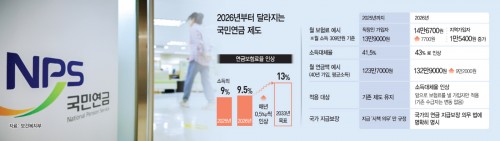
According to the Ministry of Health and Welfare, the contribution rate for the National Pension will rise to 9.5% of monthly income from next year. The rate had remained frozen at 9% for 27 years since 1998, but mounting fiscal pressure driven by low birthrates and rapid population aging prompted the phased increase. The rate will rise by 0.5 percentage points annually, reaching 13% by 2033.
As a result, both employees and self-employed contributors will pay more. For an employee earning an average monthly income of 3.09 million won, the monthly contribution will increase by 7,700 won, from 139,000 won to 146,700 won. Self-employed contributors, who pay the full amount themselves, will see a monthly increase of 15,400 won.
At the same time, pension benefits will grow. From next year, the income replacement ratio will rise to 43%. A contributor with an average lifetime monthly income of 3.09 million won who pays into the system for 40 years would see their monthly pension increase from 1.237 million won to 1.329 million won—an increase of 92,000 won. The higher replacement ratio will apply only to future contributors; current pension recipients will see no change in their benefits.
Support for younger and vulnerable groups will also expand. Childbirth credits will be granted starting from the first child, with 12 months of contribution history recognized per child, and the previous 50-month cap will be removed. Military service credits will double from a maximum of six months to 12 months.
Beginning next year, regional subscribers earning less than 800,000 won per month will be eligible for a government subsidy covering 50% of their pension contributions for up to 12 months, regardless of prior payment history. The number of beneficiaries will expand from 193,000 to 736,000, with a maximum monthly subsidy of 37,950 won.
The earnings-related pension reduction system will also be eased. Two lower reduction brackets applied to pensioners with income above a certain threshold will be abolished, ensuring that pensions are no longer reduced for those earning only slightly above the average. The revised rules will take effect in June 2026.
In addition, the government has formally written the state’s obligation to guarantee pension payments into law, clarifying that pension benefits will continue under state responsibility even after the fund is eventually depleted.
The reform follows record-breaking fund performance. The ministry estimates the pension fund’s annual return for this year at around 20%, the highest since the system’s launch in 1988. The fund’s total assets are projected to reach 1,473 trillion won, up 260 trillion won, or 21.4%, from the end of last year—equivalent to nearly six times last year’s pension benefit payouts.
Health and Welfare Minister Jung Eun-kyeong said the reform focuses on “enhancing the system’s sustainability through contribution rate adjustments and strong fund management, while strengthening real retirement income through a higher income replacement ratio and expanded childbirth and military service credits,” adding that it would mark “a turning point in restoring public trust in the national pension system.”
#National Pension Service #pension reform #contribution rate hike #income replacement ratio #youth support
Copyright by Asiatoday
Most Read
-
1
Celltrion nears additional contract with major U.S..

-
2
Putin proposes trilateral U.S.-China-Russia summit..

-
3
U.S. weighs dropping MOAB, world's most powerful n..

-
4
"Aren't those foreigners on welfare?": M..

-
5
Attention centers on APEC for possible Trump-Xi-Pu..

-
6
Saudi Arabia, Iran hold first diplomatic talks to..

-
7
U.S., Israel plan to resume strikes on Iran after..

PEOPLE






-
Address : In-Young Bldg., 34, Uisadang-daero 1-gil, Yeongdeungpo-gu, Seoul
Copyright by ASIATODAY CO., LTD. All rights resereved