



U.S. index ETFs dominate Korean market inflows
Dec 29, 2025, 09:41 am


 |
Despite South Korea’s exchange-traded fund (ETF) market surpassing 300 trillion won in assets, retail investors have overwhelmingly concentrated their money in ETFs tracking major U.S. stock indices, particularly the S&P 500 and Nasdaq 100.
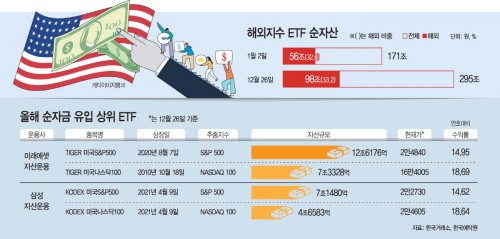
According to data from Koscom’s ETF Check on Dec. 28, the largest inflows this year among equity ETFs were recorded in products tracking flagship U.S. indices. Mirae Asset Global Investments’ TIGER U.S. S&P 500 ETF attracted 4.14 trillion won, the highest inflow among domestic listings. It was followed by Samsung Asset Management’s KODEX U.S. S&P 500 (2.88 trillion won), KODEX U.S. Nasdaq 100 (2.33 trillion won), and TIGER U.S. Nasdaq 100 (1.83 trillion won).
The heavy concentration of capital in U.S. index ETFs is widely attributed to strong growth expectations surrounding artificial intelligence. As investment accelerates in AI infrastructure such as semiconductors, cloud services and data centers, earnings visibility for U.S. big tech firms has improved, lifting sentiment across the S&P 500 and Nasdaq 100 as a whole.
Expectations that the Federal Reserve will begin cutting interest rates, along with seasonal optimism around the so-called “Santa rally,” also helped fuel buying interest.
Among S&P 500-linked products, Mirae Asset’s TIGER U.S. S&P 500 stands out as the largest overseas index ETF listed in Korea. The fund invests across 500 major U.S. companies, including Apple, Microsoft and Nvidia. It has net assets of about 12.6 trillion won and has posted a return of roughly 15 percent since the start of the year. With an annual total expense ratio of just 0.0068 percent, it has drawn steady demand from long-term investors seeking broad exposure to the U.S. market.
Samsung Asset Management’s KODEX U.S. S&P 500, listed in April 2021, tracks the same index and has grown to about 7 trillion won in net assets. Its year-to-date return is around 14 percent, while its total expense ratio of 0.0062 percent is slightly lower than that of its rival, making it attractive to cost-conscious investors.
In the technology-heavy Nasdaq 100 segment, Mirae Asset’s TIGER U.S. Nasdaq 100, listed in October 2010, is the oldest domestic ETF tracking the index and manages about 7 trillion won in assets. Built around leading U.S. tech firms such as Amazon, Alphabet, Apple and Nvidia, it has delivered returns of roughly 18 percent so far this year. Its long operating history has made it a benchmark vehicle for investing in U.S. technology stocks.
Samsung’s KODEX U.S. Nasdaq 100, listed in April 2021, has also gained traction, with net assets of about 4 trillion won and similar year-to-date returns of around 18 percent. Its low fee structure has supported demand from investors seeking long-term exposure to the U.S. tech sector through domestically listed ETFs.
Market experts say the key variables shaping equity markets in 2026 will be the sustainability of AI investment, inflation trends and the Fed’s monetary policy path. Major Wall Street banks have set end-2026 targets for the S&P 500 in the 7,100–8,100 range, suggesting further upside over the medium to long term.
Korean brokerages share a similar outlook. Choi Bo-won, a researcher at Korea Investment & Securities, said the expected trading range for the S&P 500 next year is 6,550 to 7,200 points, citing strong earnings prospects among information technology companies and infrastructure-related firms benefiting from increased government and corporate spending. He added that while risks remain, improving corporate fundamentals and liquidity conditions could help sustain momentum in the U.S. stock market.
#ETF market #South Korea ETF #S&P 500 #Nasdaq 100 #U.S. stock index
Copyright by Asiatoday
Most Read
-
1
Celltrion’s Omlyclo gains ground in major European..

-
2
Trump demands rates fall below 1% as Fed hikes for..

-
3
Trump makes $1 trillion bet ahead of midterm elect..

-
4
Iran resumes ballistic missile production, assembl..

-
5
Trump warns countries not helping U.S. must pay re..

-
6
Apple launches first foldable, 1 million won prici..

-
7
Turkish Airlines named main club partner of Liverp..

PEOPLE







-
Address : In-Young Bldg., 34, Uisadang-daero 1-gil, Yeongdeungpo-gu, Seoul
Copyright by ASIATODAY CO., LTD. All rights resereved