



Fed cuts rates amid deep internal split
Dec 11, 2025, 09:42 am


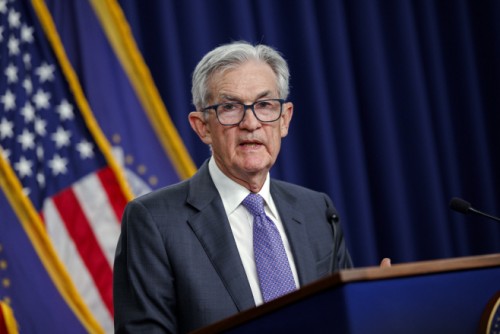 |
| Federal Reserve Chair Jerome Powell speaks during a press conference at the Fed headquarters in Washington, D.C., on December 10. / Source: EPA–Yonhap |
The U.S. Federal Reserve on December 10 (local time) lowered its benchmark interest rate by 0.25 percentage points, but the decision exposed the central bank’s sharpest internal disagreement in six years, with three out of twelve voting members opposing the move.
The Federal Open Market Committee (FOMC) lowered the federal funds rate to a range of 3.50–3.75%, marking the sixth rate cut since September of last year and the third reduction this year. The policy rate is now at its lowest point since October 2022.
The dissent reflected differing priorities among Fed officials over balancing inflation control with labor-market risk. Kansas City Fed President Jeffrey Schmid and Chicago Fed President Austan Goolsbee voted to hold rates steady, while Fed Governor Steve Myron maintained his dovish stance, calling for a deeper 0.50-point cut.
Fed Chair Jerome Powell said all committee members agree inflation remains too high and that labor-market conditions have softened, but acknowledged disagreement over how much weight to assign to each risk factor. “It is very unusual for tensions between our dual mandate goals to persist this long,” he said.
The Fed also announced it will begin purchasing $40 billion in U.S. Treasury securities starting December 12, signaling an additional monetary-easing push. Still, the committee emphasized a cautious approach to any further rate cuts, saying it would weigh incoming data, economic outlook changes and risk balance before adjusting rates again.
The Fed’s quarterly “dot plot” projections pointed to only one potential rate cut each in 2026 and 2027. Forecasts showed unemployment at 4.4% in 2026 and 4.2% in 2027, GDP growth at 2.3% and 2.0%, and inflation at 2.4% and 2.1%, respectively.
The Wall Street Journal wrote that the Fed “hinted it may pause rate cuts for now,” while CNBC said the central bank signaled “a tougher road ahead for further reductions.”
Powell also noted that Fed officials are split between those who favor stopping cuts now and those who believe at least one more cut this year or next may be necessary.
Addressing the inflationary impact of U.S. tariffs, Powell said that assuming no major new tariffs are imposed, goods-sector inflation is likely to peak in the first quarter of next year and remain modest thereafter—around 0.2 percentage points or less.
He added that much of the high cost burden Americans are currently experiencing stems not from today’s inflation rate, but from cost increases that became embedded during the high-inflation periods of 2022 and 2023.
U.S. inflation peaked at 9.1% year-on-year in June 2022 under the Biden administration—the highest in 40 years—before moderating to roughly 3% over the past 12 months leading up to September.
#Federal Reserve #interest rate cut #FOMC split #Jerome Powell #U.S. inflation
Copyright by Asiatoday
Most Read
-
1
Celltrion’s Omlyclo gains ground in major European..

-
2
Trump demands rates fall below 1% as Fed hikes for..

-
3
Trump makes $1 trillion bet ahead of midterm elect..

-
4
Iran resumes ballistic missile production, assembl..

-
5
Samsung Electronics, Mistral AI to jointly develop..

-
6
Trump warns countries not helping U.S. must pay re..

-
7
Apple launches first foldable, 1 million won prici..

PEOPLE






HEADLINE NEWS
- Trump to roll out ‘unprecedented welcome’ for Xi with B-2 bombers, F-22 fighters
- S. Korea, U.S., and Japan form united front on Taiwan and economic coercion..
- Trump administration moves to impose sweeping sanctions on International Cr..
- Xi to make state visit to U.S. Sept. 23-25, dispelling rumors over his heal..

-
Address : In-Young Bldg., 34, Uisadang-daero 1-gil, Yeongdeungpo-gu, Seoul
Copyright by ASIATODAY CO., LTD. All rights resereved