



Middle-class income growth hits record low
Dec 10, 2025, 09:38 am


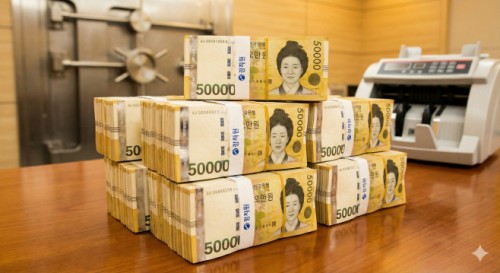 |
| A stock image of cash bundles used to illustrate income data trends. / Source: Gemini-generated image |
Income growth among Korea’s middle class hit an all-time low last year, raising concerns that the country’s economic backbone is weakening.
According to data released Wednesday by the National Data Office’s KOSIS portal, households in the third income quintile—those classified as the middle 40–60 percent bracket—earned an average of 58.05 million won last year, up just 1.8 percent from the previous year. It was the slowest pace since the statistics were first compiled in 2017.
The middle class also recorded the lowest income growth across all five quintiles. High-income households (top 20 percent) saw incomes grow 4.4 percent, while low-income households (bottom 20 percent) posted a 3.1 percent increase.
The slowdown was driven by simultaneous weakness in labor and business income, reflecting a combination of economic headwinds, worsening employment conditions and sluggish domestic demand.
Labor income, which accounts for 60 percent of total household earnings, increased only 1.5 percent to 34.83 million won—its weakest performance since 2020. Business income dropped 0.1 percent to 11.72 million won, marking its first decline since 2020.
Asset growth among middle-income households also lagged behind the national average.
This year, households in the third quintile held average assets of 425.16 million won, up 3.6 percent. Although they recovered from two consecutive years of decline, the increase fell short of the nationwide average of 4.9 percent.
Meanwhile, household debt in the same bracket surged 9.9 percent to 80.59 million won—more than double their asset growth—dragging down overall financial health. As a result, net assets rose just 2.2 percent to 344.56 million won, roughly half the national average net-asset growth rate of 5 percent.
The simultaneous slowdown in both income and asset accumulation among middle-class households has heightened concerns over widening inequality.
Last year, the average income gap between the top and bottom 20 percent of households reached 11.2 times. For labor income alone, the disparity widened to 30 times. Assets showed a similar divergence, with the wealthiest 20 percent holding 8.4 times more than the bottom 20 percent.
#middle class #income growth #KOSIS data #inequality #household assets
Copyright by Asiatoday
Most Read
-
1
Celltrion’s Omlyclo gains ground in major European..

-
2
Trump demands rates fall below 1% as Fed hikes for..

-
3
Trump makes $1 trillion bet ahead of midterm elect..

-
4
Iran resumes ballistic missile production, assembl..

-
5
Trump warns countries not helping U.S. must pay re..

-
6
Apple launches first foldable, 1 million won prici..

-
7
Turkish Airlines named main club partner of Liverp..

PEOPLE







-
Address : In-Young Bldg., 34, Uisadang-daero 1-gil, Yeongdeungpo-gu, Seoul
Copyright by ASIATODAY CO., LTD. All rights resereved