



Japan quits Vietnam reactor project, opening door for Korea
Dec 09, 2025, 09:59 am


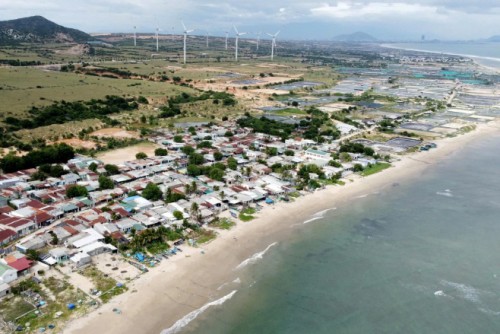 |
| A view of the area designated for the construction of Vietnam’s Ninh Thuan Unit 1 nuclear power plant. / Source: Vietnam Government Portal |
Japan has formally withdrawn from Vietnam’s Ninh Thuan Unit 2 nuclear power plant project—one of Hanoi’s key national energy initiatives. While Tokyo cited an unworkably tight construction schedule, diplomatic observers note that recent friction over Hanoi’s plan to restrict internal-combustion motorcycles may also have played a role. Japan’s departure creates fresh opportunities for “Team Korea,” which had been seeking a foothold in Vietnam’s revived nuclear program, but it also heightens anxiety among Korean manufacturers already strained by Vietnam’s chronic power shortages.
According to a Reuters report on December 8 (local time), Japan’s ambassador to Vietnam, Yamada Naoki, said in an interview that “Japan is not in a position to implement the Ninh Thuan Unit 2 project,” confirming that Tokyo is abandoning the plan.
Vietnam had initially aimed to bring the 2–3.2 gigawatt Unit 2 reactor online by 2035, alongside Unit 1, which is being handled by Russia. However, after talks last month, Japan reportedly concluded that the completion deadline was too tight and decided to withdraw.
The revival of Vietnam’s nuclear program—halted in 2016 and restarted last year—now faces turbulence from the outset. Russia has yet to sign a final contract for Unit 1, and Japan’s retreat will force Hanoi to revise its long-term Power Development Plan (PDP8).
Diplomatic sources say the reasons extend beyond construction timelines. In the same Reuters interview, Ambassador Yamada hinted at strain between Japan and Vietnam over Hanoi’s push to ban internal-combustion motorcycles in the city center by 2030 to reduce pollution. The plan threatens Honda, which controls roughly 80% of Vietnam’s motorcycle market.
Japan’s embassy in Vietnam expressed official concern in a letter to the government in September but has reportedly received no formal reply. Although Ambassador Yamada said additional consultations “may be possible,” experts believe Tokyo’s withdrawal reflects frustration over what it sees as an increasingly unfavorable environment for Japanese companies. Japan’s reluctance to pursue overseas reactor projects after the 2011 Fukushima disaster also contributed.
As Reuters noted that Korean, French, and U.S. investors are eyeing the Ninh Thuan project, Japan’s exit spells opportunity for “Team Korea.” Korea Electric Power Corp. (KEPCO) and Korea Hydro & Nuclear Power (KHNP) are positioned to highlight their strong cost competitiveness and proven ability to complete projects on schedule. With Russia’s participation clouded by sanctions and the Ukraine war, Korea could emerge as a leading alternative.
A KEPCO official told this paper, “Korea is the only country in the world capable of consistently delivering nuclear projects on time. The schedule is challenging, but adjustments can be made through consultations with the Vietnamese government, and we have conveyed our capabilities accordingly.” The official added that discussions are expected to accelerate as the nuclear agenda returns to the forefront.
Vietnam initially planned to finalize the Unit 1 contract by September and the Unit 2 contract by December. But Unit 1 remains unsigned, and Japan has now stepped away from Unit 2 entirely.
While Korea sees fresh opportunity, delays in nuclear construction could worsen the power constraints faced by Korean manufacturers in Vietnam. Companies such as Samsung Electronics and LG Electronics—major contributors to Korea’s exports—suffered production disruptions during widespread rolling blackouts last summer. A Korean business official noted, “Electricity demand is soaring due to industrial upgrading and the rise of the middle class, but supply is not keeping pace. If nuclear generation is delayed, Vietnam’s ‘power risk’ for manufacturers will inevitably persist.”
Vietnam is exploring alternatives such as small modular reactors (SMRs), but experts say these cannot fill the immediate supply gap.
#Japan withdrawal #Vietnam nuclear project #Team Korea #energy security #KEPCO/KHNP
Copyright by Asiatoday
Most Read
-
1
Celltrion’s Omlyclo gains ground in major European..

-
2
Trump demands rates fall below 1% as Fed hikes for..

-
3
Trump makes $1 trillion bet ahead of midterm elect..

-
4
Iran resumes ballistic missile production, assembl..

-
5
Samsung Electronics, Mistral AI to jointly develop..

-
6
Trump warns countries not helping U.S. must pay re..

-
7
Apple launches first foldable, 1 million won prici..

PEOPLE






HEADLINE NEWS
- Trump to roll out ‘unprecedented welcome’ for Xi with B-2 bombers, F-22 fighters
- S. Korea, U.S., and Japan form united front on Taiwan and economic coercion..
- Trump administration moves to impose sweeping sanctions on International Cr..
- Xi to make state visit to U.S. Sept. 23-25, dispelling rumors over his heal..

-
Address : In-Young Bldg., 34, Uisadang-daero 1-gil, Yeongdeungpo-gu, Seoul
Copyright by ASIATODAY CO., LTD. All rights resereved