



Judges urge caution on new tribunal plan
Dec 09, 2025, 08:20 am


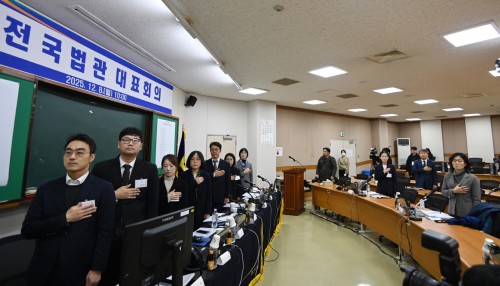 |
| Judges elected from courts nationwide salute the national flag during the National Judges’ Representatives Meeting at the Judicial Research and Training Institute in Ilsan, Goyang, on December 8. The representatives urged cautious deliberation rather than a rapid push on the ruling party’s judicial reform agenda. / Source: Yonhap News |
Nationwide judges have pushed back against the ruling party’s judicial reform initiatives, including the creation of a special tribunal for insurrection-related cases and the introduction of a “law distortion” offense, citing concerns over constitutionality and threats to judicial independence. Their statement marks the second major institutional objection from the judiciary, following a warning from chief judges on December 5 that the proposed measures could undermine the separation of powers. The message: caution and deliberation, not a legislative sprint.
A regular session of the National Judges’ Representatives Meeting was held on December 8 at the Judicial Research and Training Institute in Ilsan, Goyang. Of the 126 elected representatives nationwide, 108 took part in the hybrid on- and offline meeting. The body serves as a forum for judges selected from each court to articulate views on judicial administration and judicial independence.
In opening remarks, Kim Ye-young, presiding judge at the Seoul Southern District Court and chair of the session, said: “All judges not only respect the legislative authority of the National Assembly and the debates in political, academic, and civic arenas, but also hope that any institutional reform fully reflects the court’s views and meets the expectations of the public.”
After more than six hours of deliberation, the representatives concluded that although they “take seriously the importance of trials related to martial law and the immense public concern surrounding them,” the current proposals raise significant constitutional and independence issues. They urged the National Assembly to proceed with “careful deliberation” on both the bill establishing a special tribunal for martial-law cases and the Criminal Act amendment introducing the offense of law distortion.
The special tribunal has drawn criticism for undermining the principle of random case assignment, thereby threatening the right to a fair trial. Adding to the controversy, the tribunal’s composition would allow participation by actors outside the judiciary, a design critics say infringes on judicial independence and violates the separation of powers.
The proposed law distortion offense has also raised alarm for its vague standards, which judges warn could chill judicial and prosecutorial decision-making. Depending on who is empowered to determine what constitutes distortion, the provision could become a political tool for punitive intervention.
At their own nationwide meeting on December 5, chief judges warned that the two bills “erode trial neutrality and public trust in the judiciary,” and ultimately infringe on the constitutional right to a fair trial. Even the Rebuilding Korea Party—considered broadly aligned with the ruling bloc—voiced concern on Monday that the special tribunal bill “clearly carries constitutional risks.”
With opposition mounting inside and outside the legal community, the ruling party has begun to slow its push. Although the two bills were initially scheduled for handling at a December 9 plenary session, party officials have decided to continue discussions to address the constitutional concerns. The Supreme Court’s Administrative Office will also hold a three-day public hearing starting December 9 to discuss the future direction of judicial reform.
#judicial independence #special tribunal #law distortion offense #constitutional concerns #separation of powers
Copyright by Asiatoday
Most Read
-
1
Celltrion’s Omlyclo gains ground in major European..

-
2
Trump demands rates fall below 1% as Fed hikes for..

-
3
Hyundai Motor Group breaks ground on integrated st..

-
4
U.S. strikes 3 Iranian oil tankers, Iran vows reta..

-
5
Trump makes $1 trillion bet ahead of midterm elect..

-
6
Iran resumes ballistic missile production, assembl..

-
7
Samsung Electronics, Mistral AI to jointly develop..

PEOPLE







-
Address : In-Young Bldg., 34, Uisadang-daero 1-gil, Yeongdeungpo-gu, Seoul
Copyright by ASIATODAY CO., LTD. All rights resereved