



Fed split ahead of rate cut raises market concerns
Dec 08, 2025, 09:20 am


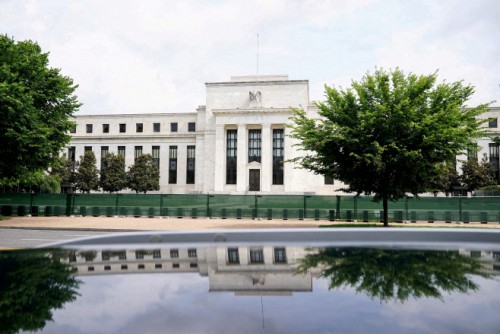 |
| The Federal Reserve building is seen in Washington, D.C., in a photo taken on June 14, 2022. / Reuters–Yonhap |
The U.S. Federal Reserve is widely expected to cut its benchmark interest rate by 0.25 percentage points at the Federal Open Market Committee (FOMC) meeting on December 9–10, but a growing number of dissenting voices within the committee is raising concerns that the central bank could send an unintended negative signal to markets.
According to the Financial Times (FT), which on December 7 published a joint survey with the University of Chicago’s Booth School of Business, 85% of 40 surveyed economists predicted a 0.25-point cut, while the remaining 15% expected the Fed to hold rates steady. None projected a 0.5-point cut. Weakening labor-market conditions were cited as the primary reason behind forecasts for a modest reduction.
Futures markets are reflecting similar expectations. CME’s FedWatch tool shows an 86.2% probability of a quarter-point cut and a 13.8% chance of no change.
While most FOMC members are leaning toward easing due to softening employment indicators, several others argue that inflation remains above the 2% annual target and caution against moving too quickly. FT reported that 60% of surveyed economists expect at least two dissenting votes at the meeting, while one-third foresee three or more. The 12 voting members of the FOMC consist of the seven Fed board governors appointed by the president and five regional Federal Reserve Bank presidents on a rotating basis.
Historical records show that dissenting votes are not uncommon but are usually limited in number. Data from the St. Louis Fed indicate that during Jerome Powell’s tenure, roughly 20% of meetings saw at least one dissenting vote, compared with nearly half under Janet Yellen and more than 60% under Ben Bernanke.
However, cases involving two or more dissenters have been rare. FT and Reuters note that only nine FOMC meetings since 1990 have had two or more dissents, the most recent being in September 2019. The last time three or more dissenting votes were cast was in 1992.
Reuters warned that if internal divisions deepen and the Fed struggles to present a unified policy message, it could weaken the credibility of its guidance and intensify questions about the central bank’s independence amid political pressures.
Bloomberg also reported that some analysts believe a fractured Fed or a “hawkish rate cut” could heighten market volatility.
#FOMC rate cut split #Fed dissent risks #market volatility concerns #inflation vs labor debate #central bank credibility
Copyright by Asiatoday
Most Read
-
1
Celltrion’s Omlyclo gains ground in major European..

-
2
Trump demands rates fall below 1% as Fed hikes for..

-
3
Trump makes $1 trillion bet ahead of midterm elect..

-
4
Iran resumes ballistic missile production, assembl..

-
5
Samsung Electronics, Mistral AI to jointly develop..

-
6
Trump warns countries not helping U.S. must pay re..

-
7
Apple launches first foldable, 1 million won prici..

PEOPLE






HEADLINE NEWS
- Trump to roll out ‘unprecedented welcome’ for Xi with B-2 bombers, F-22 fighters
- S. Korea, U.S., and Japan form united front on Taiwan and economic coercion..
- Trump administration moves to impose sweeping sanctions on International Cr..
- Xi to make state visit to U.S. Sept. 23-25, dispelling rumors over his heal..

-
Address : In-Young Bldg., 34, Uisadang-daero 1-gil, Yeongdeungpo-gu, Seoul
Copyright by ASIATODAY CO., LTD. All rights resereved