



Seoul seeks to restart North Korea talks in 2026
Dec 08, 2025, 08:23 am


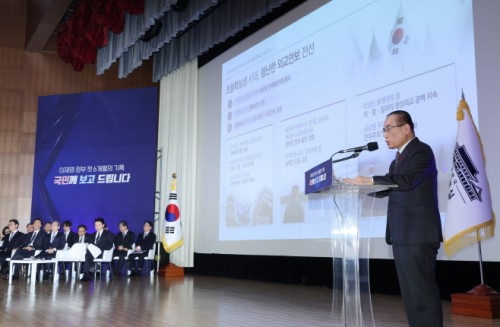 |
| National Security Advisor Wi Sung-lac speaks during a briefing on the first six months of President Lee Jae-myung’s administration at the presidential office in Yongsan, Seoul, on December 7. / Source: Yonhap News |
On December 7, National Security Advisor Wi Sung-lac said the Lee Jae-myung administration will push to reopen talks with North Korea in 2026, aiming to launch a full-fledged process for peace and coexistence on the Korean Peninsula.
Speaking at a media briefing marking the administration’s first six months, Wi said the government had “laid the groundwork to revive the Korean Peninsula peace process” and intended to “project the momentum created by these conditions back onto the peninsula.”
Wi noted that Seoul and Washington had aligned their positions on North Korea and its nuclear program, establishing defined “peacemaker” and “pacemaker” roles to enhance coordination. He added that trilateral cooperation with Japan was proceeding smoothly and that dialogue with China on peninsula issues had been restored.
“With these conditions, we will work to improve inter-Korean relations,” he said.
He also suggested that dialogue timing may depend on broader dynamics.
“It’s hard to say when inter-Korean talks might resume, and I suspect U.S.–North Korea timing may come first,” Wi said. “Whatever happens first, we will work to create a virtuous cycle that brings together the peacemaker and pacemaker roles.”
On strategies to bring Pyongyang back to the negotiating table, Wi said South Korea had “many potential options” but stressed that Seoul did not intend to use the South Korea–U.S. combined military exercises as a direct bargaining tool.
Addressing criticism of the National Security Council (NSC) structure, Wi said the current system follows “the same institutional framework and practices that have been in place since the Kim Dae-jung administration,” and noted that participation by deputy-minister-level officials dates back to the Park Geun-hye administration. His remarks were partly in response to former Unification Minister Jeong Se-hyun, who recently argued that deputy-level involvement mirrors problematic practices he linked to the previous Yoon Suk-yeol administration.
“It is not, as someone claimed, a system invented by a particular individual named Kim,” Wi said.
Meanwhile, the presidential National Security Office announced the formation of three task forces to follow up on the recent South Korea–U.S. security negotiations.
First Deputy National Security Advisor Kim Hyun-jong told reporters that teams had been established on enriched uranium, nuclear-powered submarines, and expanded defense spending.
“We are drafting a roadmap for consultations with the United States,” he said, adding that working-level talks will begin this month and that tangible progress may emerge sometime in the first half of next year.
Kim added that high-level consultations would run in parallel when necessary.
#Inter-Korean dialogue #Wi Sung-lac #Korean Peninsula peace process #South Korea–U.S. security cooperation #Nuclear-powered submarine TF
Copyright by Asiatoday
Most Read
-
1
Trump shares map on social media labeling Strait o..

-
2
Kia Sportage outperforms Mazda CX-5 in German auto..

-
3
Houthis launch successive attacks on Saudi airport..

-
4
U.S. deploys carrier, 10,000 more troops to Middle..

-
5
Trump rejects Iran's offer to open Strait of Hormu..

-
6
N. Korea conducts first swarm attack drill with dr..

-
7
U.S.-China summit falls short on substance as Trum..

PEOPLE




HEADLINE NEWS
- Seoul dismisses Ukraine's claim of 'S. Korean support for Russia' as "inaccurate and inappropriate"
- S. Korea, Japan race to develop nuclear-powered submarines
- Henri Kagan, Kenso Soai win Nobel Prize in Chemistry for uncovering how mol..
- Vance says Alaska LNG cooperation will move forward with Seoul's current or..

-
Address : In-Young Bldg., 34, Uisadang-daero 1-gil, Yeongdeungpo-gu, Seoul
Copyright by ASIATODAY CO., LTD. All rights resereved