



Chief justice urges caution on judicial reforms
Dec 04, 2025, 09:06 am


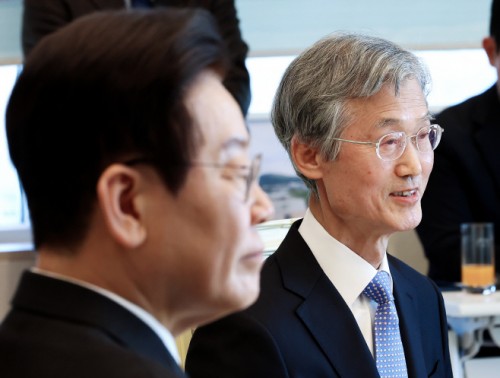 |
| Chief Justice Cho Hee-dae speaks during a luncheon hosted by President Lee Jae-myung at the Yongsan presidential office on December 3. / Source: Yonhap News |
Chief Justice Cho Hee-dae on December 3 stressed that any restructuring of South Korea’s judicial system must proceed with great care, emphasizing the courts’ constitutional role in protecting citizens’ rights and maintaining social order.
Speaking at a luncheon hosted by President Lee Jae-myung for the heads of the five branches of state, Cho said judicial reform should follow a process of “sufficient deliberation and public discussion.”
“I ask for your interest so that the reforms currently being discussed can be carried out in a way that truly serves the people,” he said.
Acknowledging that no judicial decision can satisfy everyone, Cho underscored the legitimacy of the existing three-tier court system. “The conclusions of individual trials are ultimately determined within the institutional framework of the three-instance system as defined by the Constitution and the law,” he said. “It is through this full review and procedure that judicial decisions earn their legitimacy and public trust.”
He added that he and all members of the judiciary “continue to work tirelessly to uphold the foundation of the rule of law and to fulfill our constitutional mission of protecting citizens’ rights through swift and fair trials.”
Cho’s remarks were widely interpreted as a call for caution toward reform proposals pushed by the Democratic Party, including the introduction of a constitutional appeal system that would in effect create a fourth level of review, the abolition of the Court Administration Office, and increasing the number of Supreme Court justices.
In particular, Cho’s emphasis on the “institutional framework of the three-instance system” was seen as a clear signal of his opposition to the proposed constitutional appeal mechanism.
Reflecting on the year since the December 3 martial-law declaration, Cho said it had been “a period in which each branch of government worked to fulfill its constitutional duties and restore constitutional order.” He added that the judiciary has listened to diverse public opinions and strives to strengthen its service and accountability to the people.
He also noted that the courts had made clear immediately after last year’s declaration that the martial-law move was unconstitutional. But, he cautioned, “Since related cases are currently before the courts, it would not be appropriate for me, as chief justice, to comment in detail.” He expressed confidence that “each trial bench will adjudicate swiftly and fairly in accordance with the Constitution and the law.”
#Judicial reform caution #Three-tier court system #Chief Justice Cho Hee-dae #Democratic Party reform agenda #Martial-law
Copyright by Asiatoday
Most Read
-
1
Trump shares map on social media labeling Strait o..

-
2
Kia Sportage outperforms Mazda CX-5 in German auto..

-
3
Houthis launch successive attacks on Saudi airport..

-
4
U.S. deploys carrier, 10,000 more troops to Middle..

-
5
Trump rejects Iran's offer to open Strait of Hormu..

-
6
N. Korea conducts first swarm attack drill with dr..

-
7
U.S.-China summit falls short on substance as Trum..

PEOPLE





HEADLINE NEWS
- Seoul dismisses Ukraine's claim of 'S. Korean support for Russia' as "inaccurate and inappropriate"
- S. Korea, Japan race to develop nuclear-powered submarines
- Henri Kagan, Kenso Soai win Nobel Prize in Chemistry for uncovering how mol..
- Vance says Alaska LNG cooperation will move forward with Seoul's current or..

-
Address : In-Young Bldg., 34, Uisadang-daero 1-gil, Yeongdeungpo-gu, Seoul
Copyright by ASIATODAY CO., LTD. All rights resereved