



Yoon, Han await sedition verdicts early next year
Dec 04, 2025, 09:00 am


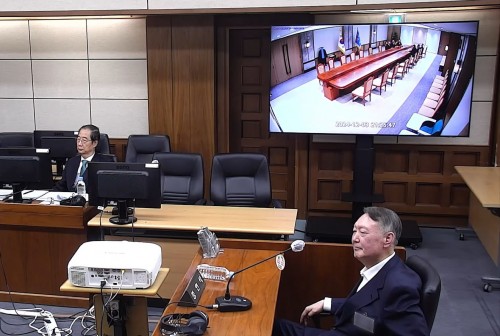 |
| Former President Yoon Suk-yeol watches CCTV evidence during the sedition trial of former Prime Minister Han Duck-soo at the Seoul Central District Court on November 19. / Source: Seoul Central District Court |
As the first anniversary of the Dec. 3 martial-law crisis has approached, the sedition trials of former President Yoon Suk-yeol and other key figures are entering their decisive phase, with first-instance verdicts expected between January and February next year.
The courts are moving quickly to deliver rulings before their regular mid-February judicial reshuffle.
Yoon’s sedition case is nearing its conclusion. After the Constitutional Court removed him from office on April 4, he was indicted on charges including leading a sedition conspiracy. The Seoul Central District Court’s Criminal Division 25, presided over by Judge Ji Gui-yeon, plans to complete hearings over three sessions on January 5, 7 and 9. Even if additional dates are required for delayed witness examinations, prosecutors are expected to make their sentencing recommendation by mid-January. Given typical timelines, a verdict is likely in February.
The same bench is also handling sedition-related trials for former Defense Minister Kim Yong-hyun, National Police Agency Commissioner General Cho Ji-ho, and other past and present security officials. The court intends to merge three related cases and hold a combined final hearing on the 29th.
A central question for the judges is whether the declaration of martial law meets the Criminal Act’s definition of sedition — namely, an attempt to “undermine the constitutional order through violent uprising.” The court must determine whether there was prior coordination, whether efforts were made to block the National Assembly from voting to lift martial law, whether arrest teams were organized to detain politicians, and whether officials attempted to seize the National Election Commission. These four issues form the core of the trial.
Under Article 87 of the Criminal Act, the leader of a sedition plot may face the death penalty or life imprisonment. Special Prosecutor Cho Eun-seok’s team is widely expected to seek the maximum sentence for Yoon. “Multiple witnesses have described detailed instructions allegedly issued to apprehend lawmakers,” said one former-judge-turned-attorney. “Even symbolically, the special counsel would likely pursue the highest penalty.”
Separately, Yoon still faces ongoing trials on charges of obstruction of official duties, abuse of power, and general espionage violations, with some proceedings only halfway complete. Another case, stemming from the special investigation into the death of Marine Cpl. Lee Myung-hyun, accuses Yoon of additional abuses of power and aiding suspect concealment — bringing the total number of his criminal cases to five this year alone.
The first verdict among indicted cabinet ministers is set for former Prime Minister Han Duck-soo. The Seoul court’s Criminal Division 33, led by Judge Lee Jin-gwan, has scheduled his first-instance ruling for January 21. Because this will be the judiciary’s first ruling on whether the Dec. 3 martial-law declaration constitutes sedition, it is expected to set an important precedent. The special counsel has requested a 15-year prison sentence.
As the trials advance, the special prosecutor’s timeline is nearing its end. Since launching its investigation on June 18 and extending its mandate three times, the sedition task force will conclude its work on the 14th. Over the course of the probe, it additionally indicted former Defense Minister Kim Yong-hyun on charges including obstruction of government functions and evidence destruction, and re-arrested Yoon in July on new allegations. The team charged more than 20 high-profile figures, including former Interior Minister Lee Sang-min and former National Intelligence Service Director Cho Tae-yong.
However, the prosecutors failed to bring charges for the most politically explosive allegation — foreign-exchange conspiracy involving North Korea — citing insufficient evidence of covert collusion. They also failed to secure an arrest warrant for Rep. Choo Kyung-ho, complicating efforts to clarify alleged interference in the National Assembly’s martial-law vote. Before wrapping up their mandate, investigators plan to summon former Justice Minister Park Sung-jae once more for questioning over alleged efforts to block probes involving Kim Keon-hee.
#Dec. 3 martial-law crisis #Yoon Suk-yeol charges #Han Duck-soo verdict #Special prosecutor investigation
Copyright by Asiatoday
Most Read
-
1
Celltrion’s Omlyclo gains ground in major European..

-
2
Trump demands rates fall below 1% as Fed hikes for..

-
3
Hyundai Motor Group breaks ground on integrated st..

-
4
U.S. strikes 3 Iranian oil tankers, Iran vows reta..

-
5
Trump makes $1 trillion bet ahead of midterm elect..

-
6
Iran resumes ballistic missile production, assembl..

-
7
Samsung Electronics, Mistral AI to jointly develop..

PEOPLE






-
Address : In-Young Bldg., 34, Uisadang-daero 1-gil, Yeongdeungpo-gu, Seoul
Copyright by ASIATODAY CO., LTD. All rights resereved