



DP pushes through key judicial bills alone
Dec 02, 2025, 09:11 am


 |
| /Source: Yonhap |
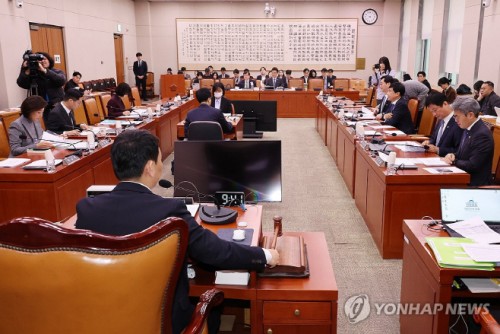
The ruling Democratic Party (DP) pushed three highly contested judicial reform bills through a subcommittee of the National Assembly’s Legislation and Judiciary Committee on Monday, triggering strong protests and a walkout by the conservative People Power Party (PPP), which denounced the move as unconstitutional.
Rep. Kim Yong-min, who chairs the first subcommittee, told reporters after the session that the panel approved the bills to establish a special court dedicated to sedition-related cases, create a new offense penalizing deliberate legal distortion by judges and prosecutors, and expand the investigative authority of the Corruption Investigation Office for High-ranking Officials (CIO).
Under the bill establishing the special sedition court, dedicated panels would be created at both the first-instance and appellate levels to oversee investigations and trials related to the so-called “Kim Keon-hee,” “sedition,” and “fallen Marine” special counsel probes. The new “legal distortion” offense would allow punishment of judges or prosecutors who intentionally manipulate legal interpretation or factual determinations during trials or investigations. A CIO amendment would also broaden the agency’s authority to investigate any crime involving Supreme Court justices, judges, prosecutors, and police officials of senior-superintendent rank or higher.
Kim said that if the bill passes the full committee and the plenary session, courts would appoint special judges to handle warrants in sedition-related cases, and detention periods for sedition and external-threat crimes could be extended to up to one year. A nine-member recommendation committee—excluding political parties—would be formed by nominations from the chief justice of the Constitutional Court, the justice minister, and the council of judges.
PPP lawmakers exited the meeting in protest, later holding a press conference. Rep. Na Kyung-won condemned the legislation as unconstitutional and said the party was considering requesting a constitutional review. “This bill signals the end of liberal democracy and the rule of law in the Republic of Korea,” she said.
The DP aims to pass the reform package within the year.
Most Read
-
1
Trump shares map on social media labeling Strait o..

-
2
Kia Sportage outperforms Mazda CX-5 in German auto..

-
3
Houthis launch successive attacks on Saudi airport..

-
4
U.S. deploys carrier, 10,000 more troops to Middle..

-
5
Trump rejects Iran's offer to open Strait of Hormu..

-
6
N. Korea conducts first swarm attack drill with dr..

-
7
U.S.-China summit falls short on substance as Trum..

PEOPLE






HEADLINE NEWS
- Seoul dismisses Ukraine's claim of 'S. Korean support for Russia' as "inaccurate and inappropriate"
- S. Korea, Japan race to develop nuclear-powered submarines
- Henri Kagan, Kenso Soai win Nobel Prize in Chemistry for uncovering how mol..
- Vance says Alaska LNG cooperation will move forward with Seoul's current or..

-
Address : In-Young Bldg., 34, Uisadang-daero 1-gil, Yeongdeungpo-gu, Seoul
Copyright by ASIATODAY CO., LTD. All rights resereved