



Audit Board Split Deepens After Power Change
Nov 24, 2025, 09:32 am


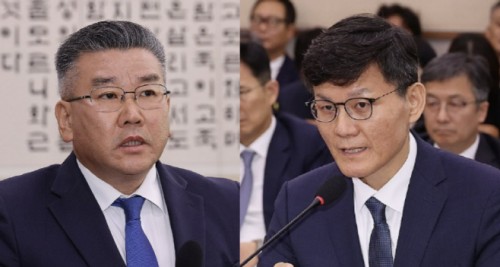 |
| Audit Commissioner Yoo Byung-ho (left) and Board of Audit and Inspection Secretary-General Jung Sang-woo. / Source: Yonhap News |
South Korea’s Board of Audit and Inspection (BAI), constitutionally designed to function as an independent watchdog, is mired in an unprecedented internal feud that appears to pit officials aligned with the former and current administrations against each other. Critics warn that politically driven “code audits” — reversing findings depending on which government is in power — are undermining the BAI’s independence and fueling the infighting.
The conflict centers on an Operational Reform Task Force, launched to rectify alleged problems during the Yoon Suk Yeol administration. In an interim report released on November 20, the task force said it had found illegal or improper conduct “from the initiation to the processing and overall execution” of an audit on public officials’ duty management. The statement effectively acknowledged that a June 2023 special audit of then–Anti-Corruption and Civil Rights Commission (ACRC) Chair Jeon Hyun-hee — often dubbed the “ACRC audit” — may have been a targeted probe.
The interim findings triggered immediate backlash inside the agency. Kim Young-shin, an audit commissioner who led the ACRC audit as head of the Public Inspection Bureau at the time, issued a statement the next day calling the task force’s report “a biased result that distorts facts.” Such open dissent by a sitting commissioner is rare and highlights the depth of the BAI’s internal fracture.
The leadership change following the December 3 emergency martial law crisis and the ensuing early presidential election has sharpened tensions between holdovers from the previous administration and appointees of the new government. A focal point of that clash is the operational reform task force launched on September 16, spearheaded by newly appointed Secretary-General Jung Sang-woo, who took office on September 10. Under Jung’s direction, the task force began a sweeping review of the so-called “seven major audits,” including the ACRC case, allegations of statistical manipulation, and claims related to the West Sea civil servant shooting cover-up. Critics argue the reviews target audits that the ruling party had already labeled “problematic,” raising concerns of political bias.
In the process, Audit Commissioner Yoo Byung-ho — widely seen as a key power broker under the Yoon administration — was identified by critics as central to the alleged targeted audits. Yoo has fiercely pushed back and confronted the task force head-on. At a National Assembly audit hearing in October, he said the task force was “entirely illegal in its legal basis, procedures, activities and content.” He has since continued unusually theatrical acts of protest, including playing a satirical song for staff at a former BAI chief’s retirement ceremony and giving Jung a gag gift.
With the task force’s final report due in early December, the rift is expected to deepen further. Observers say the core issue is whether the BAI can escape political influence and maintain consistent audit standards regardless of which party holds power. “If the agency cannot become substantively independent from political pressure, restoring public trust will be difficult,” a person familiar with the BAI said. “Establishing consistent audit criteria untethered to the government of the day is urgently needed.”
Most Read
-
1
Celltrion’s Omlyclo gains ground in major European..

-
2
Trump demands rates fall below 1% as Fed hikes for..

-
3
Hyundai Motor Group breaks ground on integrated st..

-
4
U.S. strikes 3 Iranian oil tankers, Iran vows reta..

-
5
Trump makes $1 trillion bet ahead of midterm elect..

-
6
Iran resumes ballistic missile production, assembl..

-
7
Samsung Electronics, Mistral AI to jointly develop..

PEOPLE







-
Address : In-Young Bldg., 34, Uisadang-daero 1-gil, Yeongdeungpo-gu, Seoul
Copyright by ASIATODAY CO., LTD. All rights resereved