



Ruling, opposition clash over 728 trillion won budget
Nov 18, 2025, 09:51 am


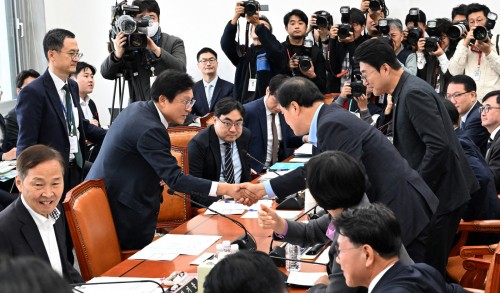 |
| Lawmakers from the ruling and opposition parties exchange greetings before the first meeting of the National Assembly’s Special Committee on Budget and Accounts’ Subcommittee on Budget Adjustment at the National Assembly in Seoul on November 17. / Source: Song Ui-joo |
The National Assembly has begun full-scale deliberations on next year’s 728 trillion won budget. From the very first day of the Special Committee on Budget and Accounts’ Subcommittee on Budget Adjustment on November 17, the ruling and opposition parties clashed repeatedly.
On the first day of the budget subcommittee, lawmakers reviewed the draft budgets for ministries and institutions including the Fair Trade Commission, the Financial Services Commission, the Ministry of Justice, the Ministry of Government Legislation, the Constitutional Court and the Supreme Court, scrutinizing whether to cut or increase funding for individual programs.
Based on the results of budget reviews conducted by each standing committee, the budget adjustment subcommittee decides the final scale of increases and cuts to next year’s overall budget.
During the deliberations, the parties locked horns over a series of items: special activity expenses, funding to support investment in the United States, as well as local love gift certificates, the National Growth Fund and basic income — programs widely referred to as President Lee Jae-myung’s “signature budgets.”
The Democratic Party of Korea (DPK) stressed the need to maintain an “expansionary fiscal” stance and pushed for additional spending, while the People Power Party (PPP) tried to put the brakes on, citing concerns over rising public debt.
In particular, fierce confrontation erupted over the 1.9 trillion won policy finance package the government inserted into next year’s budget as a follow-up to the recently concluded Korea–U.S. tariff negotiations, aimed at supporting Korean companies’ investments in the U.S.
The related funds were allocated as follows: 630 billion won for the Korea Development Bank under the jurisdiction of the National Policy Committee; 570 billion won in contributions to the Korea Trade Insurance Corporation under the Trade, Industry, Energy, SMEs and Startups Committee; and 700 billion won for the Export–Import Bank of Korea under the Strategy and Finance Committee.
However, the PPP branded these as “black box budgets” and pushed back. During committee-level budget deliberations, the National Policy Committee voted to cut the Korea Development Bank’s 630 billion won allocation in half to 315 billion won, while the Trade, Industry, Energy, SMEs and Startups Committee reduced the 570 billion won item to 470 billion won.
On November 17, the parties again clashed over the 700 billion won earmarked for the Export–Import Bank’s trade response program, forcing a brief recess. After discussions between the ruling and opposition floor managers, they agreed to keep the government’s original amount.
Park Soo-young, PPP lawmaker and opposition floor manager on the subcommittee, said, “Through talks between the floor managers, we agreed not to cut the amount. But because the necessary legal and fund frameworks are not yet in place, we will keep the original allocation by placing it in the contingency reserve for designated purposes.”
The parties also remained sharply divided over the size of the presidential office’s special activity expenses and contingency reserves.
The PPP signaled it would push for steep cuts, pointing out that the DPK had completely eliminated these funds during the previous Yoon Suk Yeol administration and calling that a precedent.
Meanwhile, the ruling and opposition blocs are expected to continue a fierce tug-of-war over the 728 trillion won budget, which represents an 8.1 percent increase from this year’s total.
Currently, Representative Han Byung-do of the Democratic Party serves as chair of the budget adjustment subcommittee under the Special Committee on Budget and Accounts.
On the subcommittee, the DPK is represented by lawmakers Lee So-young, Song Ki-heon, Kim Han-kyu, Lee Jae-gwan, Lim Mi-ae, Cho Gye-won, Noh Jong-myeon and Park Min-gyu. The PPP side includes Park Hyung-soo, Choi Hyung-du, Kang Seung-kyu, Cho Jung-hoon, Kim Ki-woong and Kim Dae-sik.
The statutory deadline for passing the budget is December 2. However, with the parties still at odds over a proposed parliamentary probe into the government’s decision to drop the appeal in the Daejang-dong development corruption case, as well as the issue of ratifying the Korea–U.S. tariff agreement, it remains unclear whether they will meet that deadline. Once the budget adjustment subcommittee adopts its decisions, the draft budget will go to the full Special Committee on Budget and Accounts and then to a plenary session of the National Assembly for final approval.
Most Read
-
1
Trump shares map on social media labeling Strait o..

-
2
Kia Sportage outperforms Mazda CX-5 in German auto..

-
3
Houthis launch successive attacks on Saudi airport..

-
4
U.S. deploys carrier, 10,000 more troops to Middle..

-
5
Trump rejects Iran's offer to open Strait of Hormu..

-
6
N. Korea conducts first swarm attack drill with dr..

-
7
U.S.-China summit falls short on substance as Trum..

PEOPLE





HEADLINE NEWS
- Seoul dismisses Ukraine's claim of 'S. Korean support for Russia' as "inaccurate and inappropriate"
- S. Korea, Japan race to develop nuclear-powered submarines
- Henri Kagan, Kenso Soai win Nobel Prize in Chemistry for uncovering how mol..
- Vance says Alaska LNG cooperation will move forward with Seoul's current or..

-
Address : In-Young Bldg., 34, Uisadang-daero 1-gil, Yeongdeungpo-gu, Seoul
Copyright by ASIATODAY CO., LTD. All rights resereved