



Kori-2 reactor cleared to restart in February
Nov 14, 2025, 08:12 am


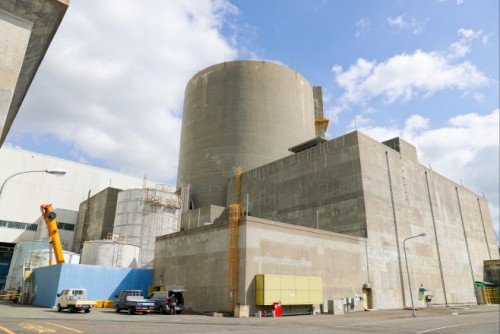 |
| Kori Nuclear Power Plant Unit 2 is seen in this undated photo. / Source: Korea Hydro & Nuclear Power |
More than two and a half years after it was taken offline, the Kori Nuclear Power Plant Unit 2 has received approval to continue operating, a decision expected to give momentum to the restart of other aging reactors. Environmental groups condemned the vote as invalid, arguing that safety has not been fully ensured and signaling legal action.
The Nuclear Safety and Security Commission (NSSC) said Thursday it had approved the “continued operation of Kori Nuclear Power Plant Unit 2” at its 224th meeting. Of the six commissioners in attendance, five voted in favor, passing the motion by a clear majority. Kori-2 is a 685 megawatt-electric (MWe) pressurized water reactor that began commercial operation in 1983 and was shut down in April 2023 when it reached the end of its original design life. With Thursday’s decision, the unit is now allowed to operate until April 8, 2033.
The Korea Institute of Nuclear Safety (KINS), which is under the NSSC, had previously conducted a safety review over roughly three years and four months, while the Nuclear Safety Experts Committee carried out a preliminary review for about seven months. Both bodies concluded that Kori-2 met the requirements for continued operation. During Thursday’s meeting, commissioners examined lifetime assessments of structures, systems and components, as well as equipment replacement plans, and concluded that sufficient safety margins could be secured during the extended operating period and that all radiological environmental impact assessments met safety standards.
NSSC Chair Choi Won-ho said, “During the meeting, several commissioners pointed out various concerns over safety, including gaps in regulations and ambiguous provisions,” adding, “We ask KHNP not to rush the restart and to thoroughly verify not only the safety of equipment replacements but also the overall readiness for operation so that local residents can feel reassured.”
Korea Hydro & Nuclear Power (KHNP) plans to carry out equipment replacements to secure additional safety margins at Kori-2. The unit will only be restarted once the NSSC completes on-site inspections and confirms that the work is compliant. Kori-2 is expected to resume operation around February next year, after a three-month equipment upgrade period that includes replacing components whose verified service life has expired and implementing design changes to link accident management systems—measures that are mandatory for life-extension restarts.
Industry officials say the continued operation approval for Kori-2 could accelerate reviews for other aging reactors with pending restart applications. In the past, Kori-1 received a 10-year life extension after its design life ended and operated until 2017, while Wolsong-1 was approved for continued operation until 2022 but was shut down early in 2019. Currently, Kori-3 and -4, Hanbit-1 and -2, and Hanul-1 and -2 have applied for operating license amendments, and Wolsong-2, -3 and -4 are in the process of setting targets for continued operation.
Environmental groups argue that the NSSC approved Kori-2’s life extension based on an inadequate safety review and say they will challenge the decision in court. Last month, they filed a lawsuit seeking confirmation of the invalidity of the NSSC’s decision to convene a meeting to deliberate and vote on the Kori-2 continued operation plan, along with a request for an injunction to suspend the process.
Park Sang-hyun, co-executive director of the Busan Anti-Nuclear Citizens’ Alliance, said, “The environmental impact assessment carried out without first reviewing the accident management plan is void of legal effect,” adding, “We cannot accept a vote that was pushed through when all nine NSSC commissioner seats were not filled, and we will fight this to the end through an injunction and the main lawsuit.”
Most Read
-
1
Celltrion’s Omlyclo gains ground in major European..

-
2
Trump demands rates fall below 1% as Fed hikes for..

-
3
Hyundai Motor Group breaks ground on integrated st..

-
4
U.S. strikes 3 Iranian oil tankers, Iran vows reta..

-
5
Trump makes $1 trillion bet ahead of midterm elect..

-
6
Iran resumes ballistic missile production, assembl..

-
7
Samsung Electronics, Mistral AI to jointly develop..

PEOPLE






-
Address : In-Young Bldg., 34, Uisadang-daero 1-gil, Yeongdeungpo-gu, Seoul
Copyright by ASIATODAY CO., LTD. All rights resereved