



U.S. tariff investigation raises concerns over broader pressure on Korea's industrial policies
Nov 26, 2026, 04:31 pm


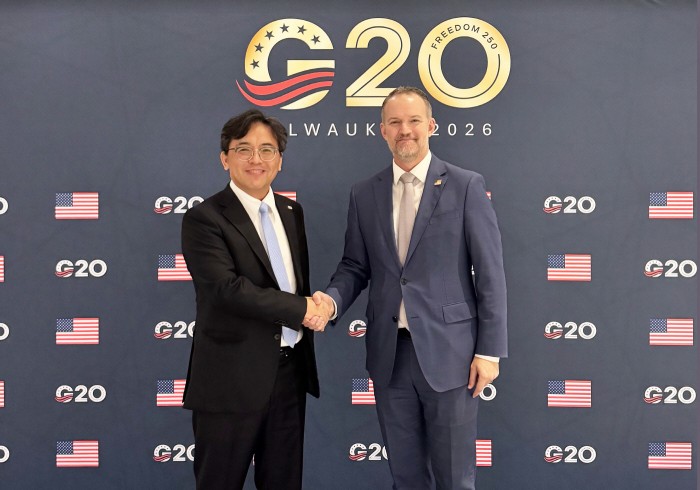 |
| Minister for Trade Park Jung-sung held bilateral talks with U.S. Trade Representative Jamieson Greer on the sidelines of the Group of 20 (G20) trade ministers' meeting in Milwaukee, Wisconsin, last month. The photo shows Park and Greer shaking hands. / Ministry of Trade, Industry and Resources |
The U.S. has taken issue with South Korea's policies to foster strategic industries, including its semiconductor megaproject, through its Section 301 trade investigation, raising the possibility that trade pressure could extend beyond tariffs to encompass South Korea's industrial policies as a whole. Policy financing, corporate support measures and government-led industrial development policies have all been cited as evidence of structural excess capacity and production.
Concerns are mounting that the U.S. could not only raise tariff rates but also challenge the direction of South Korea's industrial policies. The government plans to continue making the case that its policies are unrelated to structural excess capacity and production while focusing on maintaining the 15 percent tariff rate agreed upon under the existing South Korea-U.S. tariff agreement.
According to the Ministry of Trade, Industry and Resources on November 26, the Office of the U.S. Trade Representative (USTR) released the results of its investigations under Section 301 of the Trade Act into structural excess capacity and production in manufacturing sectors across 16 economies, including South Korea, on November 25 (local time).
The USTR launched the investigations on March 11, examining the policies and practices of 16 economies, including South Korea, China and the European Union (EU). In its reports, the USTR proposed baseline tariff rates for 14 of the 16 economies, excluding Norway and Mexico, taking into account existing tariff levels, the outcomes of bilateral consultations, the terms of trade agreements and trade balances.
The USTR proposed a 15 percent tariff on South Korean goods. However, it also explicitly left open the possibility of raising tariff rates to 25 percent for South Korea, 20 percent for Japan, 20 percent for the EU, 40 percent for China and 25 percent for Taiwan if the outcomes of future consultations or commitments are deemed unsatisfactory.
Above all, the USTR's reports took issue with a wide range of South Korean policies, from past industrial development initiatives to the recent semiconductor megaproject, policy financing and corporate support measures. This has raised concerns that the U.S. could not only raise tariffs but also challenge the South Korean government's policies to foster strategic industries and its methods of supporting businesses in future trade negotiations.
“We have consistently made it clear that our government is by no means intervening through national policies with the intention of creating the structural excess supply alleged by the U.S.,” a senior ministry official said at a background briefing with reporters that day.
Given the highly detailed questions raised by the U.S. during the investigation, the government had anticipated a wide range of issues being raised. However, it maintains that much of the evidence cited in the actual report is difficult to accept.
“It would be an overinterpretation to assume that each individual factor cited in the report determines the tariff rate,” the official explained. “To some extent, the U.S. has listed various industrial policies to substantiate its claims of excess production.”
One of the issues singled out by the U.S. is the South Korean government's policies to foster strategic industries, including its semiconductor megaproject. With even large-scale investments and support measures aimed at strengthening the semiconductor industry's competitiveness being cited as evidence of structural excess capacity and production, concerns are growing that the government's room for maneuver in industrial policymaking could narrow.
However, the government maintains that it is difficult to view the report as a direct challenge by the U.S. targeting a specific project.
“The report presents South Korea's industrial policies dating back to the 1960s and 1970s in chronological order,” the official explained. “Rather than specifically targeting the semiconductor megaproject, the U.S. appears to have listed various policies it considers problematic to substantiate its claims of excess production.”
“We will continue to explain that the overall objective of our government's industrial and corporate support policies is not to induce structural excess supply,” the official stressed.
Another factor is the possibility that booming semiconductor exports could lead to additional U.S. trade pressure. Concerns have emerged that South Korea's semiconductor competitiveness and growing exports could become targets of U.S. scrutiny, as was the case in past semiconductor trade disputes between the U.S. and Japan.
“Semiconductor exports are responding to large-scale investment in the U.S. and global demand. Rather than creating excess supply, they are helping meet surging demand,” the official stressed.
The government also rejected the U.S. criticism of its support measures for restructuring the petrochemical industry. The ministry explained that the government was facilitating voluntary business restructuring by the private sector rather than pursuing a state-led policy that creates excess supply. It also maintained that the procurement of Chinese-made components and investment activities by Chinese companies could not constitute evidence that the South Korean government was inducing global excess supply.
Although the U.S. has stipulated that the tariff rate could be raised to 25 percent if the implementation of commitments proves insufficient, the government plans to work toward having the final tariff rate set at 15 percent, in line with the bilateral agreement.
“In our communications with the USTR, we conveyed the importance of respecting the South Korea-U.S. tariff agreement and received confirmation from the U.S. side,” the official said. “Ultimately, we expect the tariff rate applied to South Korea to remain at the level agreed upon in the bilateral tariff negotiations.”
However, as managing South Korea's trade surplus with the U.S. and expanding imports of American products remain challenges in responding to future trade issues, the government plans to continue increasing purchases of U.S. energy products and aircraft, among other measures incorporated into last year's bilateral tariff agreement.
“The two countries are consulting closely based on the fact sheet accompanying the South Korea-U.S. tariff agreement, and implementation of the commitments has been progressing steadily so far, albeit at varying speeds,” the ministry official said. “Until the final tariff decision is made, we will actively make the case to the U.S. that South Korea is not an economy with structural excess capacity and production.”
Kim Jeong-kyu
Most Read
-
1
China President Xi's Keynote Speech at the APEC C..

-
2
Alice Huang, affair partner of Jensen Huang, repor..

-
3
Iran resumes attacks after two months, targeting U..

-
4
Russian warship sinks in suspected drone attack at..

-
5
Inside Kylin Villa, the symbol of China's reform h..

-
6
Trump, Xi, Putin call for security cooperation at..

-
7
Trump, Putin, Zelenskyy may hold peace talks at G2..

PEOPLE





-
Address : In-Young Bldg., 34, Uisadang-daero 1-gil, Yeongdeungpo-gu, Seoul
Copyright by ASIATODAY CO., LTD. All rights resereved