



Wall Street swings sharply amid AI profitability fears and tariff uncertainty
Nov 26, 2026, 09:53 am


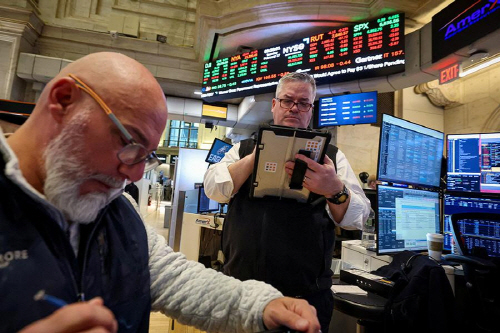 |
| Traders work on the floor of the New York Stock Exchange on Wall Street in New York City on November 25 (local time). As a sell-off in AI-related stocks led by Nvidia continued, the Dow fell more than 1,000 points in early trading and the Nasdaq dropped around 4 percent, but both recovered much of their losses. / UPI-Yonhap |
U.S. stocks experienced sharp volatility on November 25 (local time), plunging during the session as concerns over the profitability of AI investments coincided with U.S. moves to expand tariffs. The tech-heavy Nasdaq plunged more than 4 percent intraday but recouped much of its losses as dip buyers stepped in.
The Dow Jones Industrial Average closed at 50,182.95, up 164.25 points (0.33 percent) from the previous session. The S&P 500 fell 18.31 points (0.25 percent) to 7,182.78, while the Nasdaq Composite dropped 147.73 points (0.62 percent) to 23,585.80.
Nvidia shares fell more than 9 percent intraday before paring losses to close 3.91 percent lower.
Regarding the weakness in technology stocks, Reuters noted that investors remain unconvinced that massive investments in AI infrastructure will generate sufficient returns. Rising capital expenditures for data center construction and concerns that debt-financed investment expansion is adding to companies' financial burdens have also dampened investor sentiment.
The rebound in technology stocks following the return of Nvidia CEO Jensen Huang also lost momentum after just two days. AI-related stocks, including Nvidia, came under pressure as the sell-off spread across the semiconductor sector.
However, the major indexes pared their losses as dip buying followed the sharp intraday declines. Ahead of the Thanksgiving holiday, investors appeared to focus on buying technology stocks that had fallen sharply.
The Donald Trump administration's push for additional tariffs also heightened market uncertainty. The U.S. government announced that day that it would impose new 20 percent tariffs on major trading partners, including China and the European Union (EU). Concerns also mounted that higher tariffs could push up import prices and increase costs for businesses.
The final estimate of U.S. gross domestic product (GDP) for the third quarter, released that day, showed growth at an annualized rate of 4.3 percent, exceeding market expectations. However, the personal consumption expenditures (PCE) price index rose 3.8 percent year-on-year in October, while core PCE inflation, which excludes volatile food and energy prices, reached 3.3 percent.
With economic growth remaining robust and inflationary pressures persisting, expectations for interest rate cuts by the Federal Reserve (Fed) also faded. Growing concerns over monetary tightening added further pressure on stocks. U.S. stock markets will be closed on November 26 for Thanksgiving and will operate on a shortened trading schedule on November 27.
Cheon Hyun-bin
Most Read
-
1
China President Xi's Keynote Speech at the APEC C..

-
2
Alice Huang, affair partner of Jensen Huang, repor..

-
3
Iran resumes attacks after two months, targeting U..

-
4
Russian warship sinks in suspected drone attack at..

-
5
Inside Kylin Villa, the symbol of China's reform h..

-
6
Trump, Xi, Putin call for security cooperation at..

-
7
Trump, Putin, Zelenskyy may hold peace talks at G2..

PEOPLE







-
Address : In-Young Bldg., 34, Uisadang-daero 1-gil, Yeongdeungpo-gu, Seoul
Copyright by ASIATODAY CO., LTD. All rights resereved