



Russia sends humanoid robot to ISS to assist astronauts
Nov 26, 2026, 09:14 am


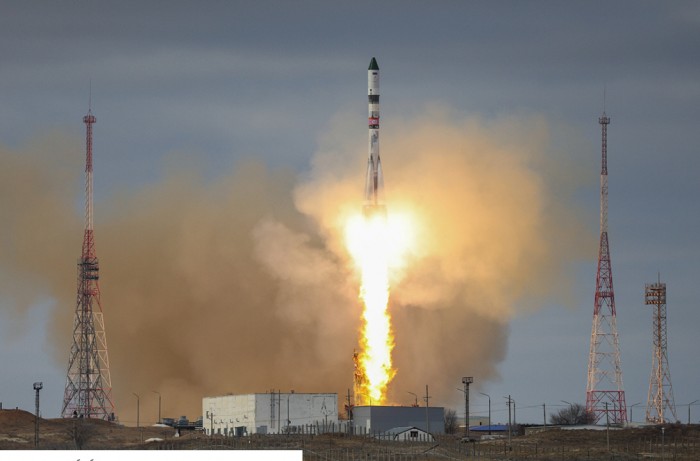 |
| A Soyuz-2.1b rocket carrying Russia's uncrewed Progress MS-36 cargo spacecraft lifts off from the Baikonur Cosmodrome in Kazakhstan on November 24 (local time). / Screenshot from a video on The Associated Press' YouTube channel |
Russia has sent a humanoid space robot developed to ease astronauts' workloads to the International Space Station (ISS). The experimental project will test the robot's remote-control and autonomous operation capabilities in stages.
Kazakhstan's state-run news agency Qazinform reported on November 24 (local time) that Russia's state space corporation Roscosmos had launched a Soyuz-2.1b rocket carrying the uncrewed Progress MS-36 cargo spacecraft from the Baikonur Cosmodrome in Kazakhstan.
The spacecraft carried more than 2.4 metric tons of cargo, including food and equipment destined for the ISS, as well as a humanoid robot called Teledroid for experimental testing.
Developed by Russia's Scientific and Production Association Android Technics (NPO Android Technics), Teledroid is a remotely controlled robot modeled on the human upper body, with two arms and manipulators for performing tasks. It is designed to mimic astronauts' movements or carry out tasks according to preprogrammed commands.
The robot's primary purpose is to assist with hazardous and repetitive tasks outside the ISS. It was developed to perform tasks such as inspecting equipment and handing over tools outside the space station.
Teledroid is designed to withstand vacuum conditions, space radiation and extreme temperature fluctuations. It has 30 joints and can use both arms to handle tools needed for its tasks.
The project will proceed in stages, beginning with simulations using a virtual model, followed by tests inside the ISS and then operations outside the station. The tests will evaluate modes of operation in which the robot mimics the movements of an astronaut wearing a specialized exoskeleton aboard the station, as well as those in which the robot performs tasks autonomously.
Russia previously sent a humanoid robot called FEDOR to the ISS in 2019. At the time, tests were conducted to assess the robot's ability to mimic astronauts' movements and manipulate objects. Teledroid is an advanced model developed based on those tests, with the aim of performing tasks outside the space station as well.
Teledroid's operational capabilities have yet to be fully demonstrated. However, if the robot can eventually take over tasks that astronauts previously had to perform themselves while wearing spacesuits, it is expected to improve the safety and efficiency of space missions.
The Baikonur Cosmodrome, from which the spacecraft was launched, is the world's first space launch facility, located in the Kyzylorda Region of southern Kazakhstan. Both the launch of Sputnik 1, the world's first artificial satellite, in 1957 and Yuri Gagarin's first crewed spaceflight in 1961 took place there.
Following the dissolution of the Soviet Union and Kazakhstan's independence, Baikonur has been operated under a lease agreement with Russia. Russia has long used the facility as a major spacecraft launch site and continues to use it as a key launch hub for sending supplies and astronauts to the ISS.
Kim Min-kyu
Most Read
-
1
China President Xi's Keynote Speech at the APEC C..

-
2
Alice Huang, affair partner of Jensen Huang, repor..

-
3
Iran resumes attacks after two months, targeting U..

-
4
Russian warship sinks in suspected drone attack at..

-
5
Inside Kylin Villa, the symbol of China's reform h..

-
6
Trump, Xi, Putin call for security cooperation at..

-
7
Trump, Putin, Zelenskyy may hold peace talks at G2..

PEOPLE







-
Address : In-Young Bldg., 34, Uisadang-daero 1-gil, Yeongdeungpo-gu, Seoul
Copyright by ASIATODAY CO., LTD. All rights resereved