



Oversized food and drinks gain popularity in Japan amid rising prices
Nov 26, 2026, 03:28 pm


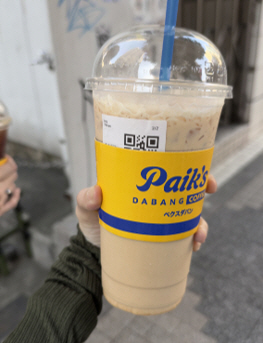 |
| A Korean coffee shop popular among office workers in Shimbashi, Tokyo, one of Japan's major business districts. / Photo by Jeong Eun-hye, Tokyo correspondent |
Larger-sized products offering greater volume or size than conventional products are gaining popularity in Japan as rising prices make consumers more cost-conscious.
From Korean-style one-liter coffees and oversized convenience store beverages to fruit and seafood, a trend toward larger-sized products is sweeping the food industry. The trend appears to be developing into a new food culture as consumers seek to make a single purchase last longer and businesses look for ways to make more efficient use of limited food ingredients.
On November 25, Japan's Nippon TV reported on the trend, covering Korean-style one-liter beverage chains that have recently been expanding, particularly in areas with a high concentration of offices.
In Shimbashi, Tokyo, one of Japan's major business districts, people walking down the street carrying one-liter coffees have become a common sight. Oversized beverages, particularly those offered by Korean coffee chains, are attracting the attention of office workers.
Korean coffee shops specializing in one-liter drinks, including Paik's Coffee and Mammoth Coffee, have opened near subway stations, where office workers can often be seen lining up to buy coffee during lunch breaks.
One reason consumers are flocking to Korean-style oversized coffees is their desire to make a single purchase last as long as possible.
One Korean coffee chain sells a café latte more than twice the size of its regular small offering for 420 yen, compared with 250 yen for the small size.
Consumers who opt for oversized beverages agree that making one drink last longer is more economical than repeatedly purchasing smaller ones. Some sip a drink purchased in the morning until their classes end, while others drink it little by little throughout the workday.
This consumption pattern is also evident at Japanese convenience stores. FamilyMart introduced a new LL size for its beverages in June this year in response to growing demand for what is known as chibidara-nomi, or sipping a drink little by little throughout the day.
The trend toward larger-sized products is not limited to beverages. Oversized fruit and seafood products have also emerged.
At a vineyard in Matsudo, Chiba Prefecture, Shine Muscat grapes around 1.5 times their usual size are being harvested. Despite their larger size, the grapes have maintained sugar levels comparable to those of previous years.
Extra-large eels, a regional specialty of Aichi Prefecture, are also attracting attention. At eel farms in the Isshiki area, 500-gram eels, roughly twice the size of regular ones, are being raised separately. Although they take about twice as long and cost about twice as much to raise as regular eels, the practice is drawing attention as a way to make efficient use of limited resources amid an annual decline in catches of juvenile eels. The idea is to produce an eel large enough to feed two people instead of the usual single serving.
Behind this growing trend toward larger and oversized food products are changing consumption patterns and business strategies.
As rising prices increase the cost of living, consumers are showing greater interest in products that offer more for the same amount of money. Demand for products that can be consumed over a longer period after a single purchase, reducing the frequency of purchases, is also driving the popularity of larger-sized products.
For businesses, offering larger-sized products is a way to differentiate their offerings from existing products. Besides providing consumers with a new purchasing experience, it can also help businesses make efficient use of resources in sectors where raw materials are difficult to secure, as is the case with eels.
However, larger sizes do not necessarily translate into better value for money. Consumers need to consider the actual purchase price, price per unit and how long the product lasts.
Jeong Eun-hye
Most Read
-
1
China President Xi's Keynote Speech at the APEC C..

-
2
Alice Huang, affair partner of Jensen Huang, repor..

-
3
Iran resumes attacks after two months, targeting U..

-
4
Russian warship sinks in suspected drone attack at..

-
5
Inside Kylin Villa, the symbol of China's reform h..

-
6
Trump, Xi, Putin call for security cooperation at..

-
7
Trump, Putin, Zelenskyy may hold peace talks at G2..

PEOPLE






-
Address : In-Young Bldg., 34, Uisadang-daero 1-gil, Yeongdeungpo-gu, Seoul
Copyright by ASIATODAY CO., LTD. All rights resereved