



Study calls for greater AI use in universities and shift toward process-based assessment
Nov 26, 2026, 02:27 pm


 |
| An AI-generated image. |
As AI-assisted exam cheating emerges as a social problem and education authorities tighten oversight and penalties, a study suggests that universities should instead actively encourage the use of artificial intelligence (AI). Students' levels of challenging learning experiences varied depending on how frequently and for what purposes they used AI, as well as the education and support provided by their universities. However, researchers point out that universities will inevitably need to shift from outcome-based to process-based assessment to evaluate students' actual thinking and problem-solving skills in an educational environment where AI use has become commonplace.
The Korean Educational Development Institute (KEDI) held an online press briefing on November 26 to release the findings of a study titled “Under What Conditions Does University Students' Use of Generative AI Lead to Challenging Learning Experiences?”
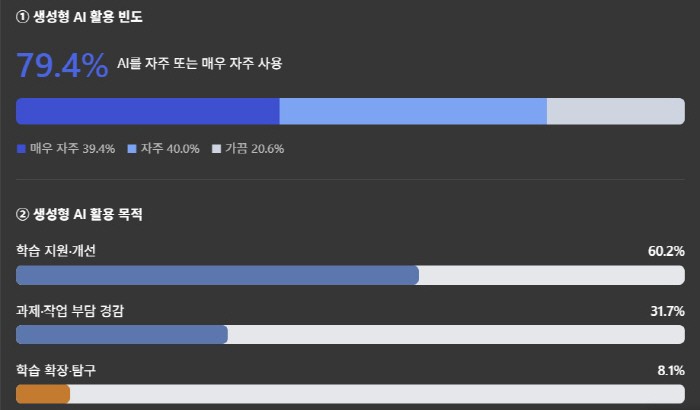
According to the study, 79.4 percent of university students who use generative AI reported using it frequently or very frequently. Drawing on data from last year's student survey on teaching, learning and innovation in higher education, researchers analyzed 30,722 students who used generative AI across 80 universities nationwide. Using multilevel modeling that controlled for students' gender, academic major, year of study and household income, as well as their universities' location, establishment type and size, the researchers examined differences in learning experiences according to the frequency and purpose of AI use and the institutional support available.
The analysis showed that students who used AI very frequently demonstrated statistically significantly higher levels of challenging learning experiences across all three domains — higher-order learning, reflective and integrative learning, and quantitative reasoning — than those who used it occasionally.
In particular, differences emerged not only in how frequently students used AI but also in what they used it for. Students in the “learning expansion and exploration” group, who used AI for creative thinking and exploring new knowledge, reported higher levels of learning experiences across all three domains than those in the “task efficiency” group, who used AI to reduce their assignment or workload burden. These differences persisted even after controlling for the frequency of AI use.
However, the most common purpose of AI use was learning support and improvement, including obtaining feedback and improving the quality of assignments, accounting for 60.2 percent of students. The task efficiency group accounted for 31.7 percent, while the learning expansion and exploration group accounted for just 8.1 percent.
Although AI use has become commonplace among university students, universities' educational and institutional responses have fallen short. While 67.9 percent of students perceived their universities as encouraging AI use, only 37.7 percent had actually received AI-related education or support from their institutions. Only 31.9 percent believed their universities had clear guidelines and policies on AI use.
In particular, actual experience of education and support, along with clear guidelines, was more closely associated with challenging learning experiences than simply encouraging AI use. The more frequently students used AI, the greater the differences in learning experiences depending on whether they received institutional support.
Limitations of outcome-based assessment: Students' thinking and problem-solving processes must be evaluated
Kim Ji-ha, a senior research fellow at KEDI, stressed the need to reform university teaching, learning and assessment systems so that AI use helps expand students' thinking and intellectual exploration. Educational design must change so that AI serves as a learning tool that enhances students' thinking and problem-solving skills rather than a tool that completes assignments on their behalf.
In particular, with AI capable of producing high-quality work in a short period of time, conventional assessment methods that judge individual students' learning capabilities solely on their final outputs have reached their limits. Rather than focusing on whether students used AI, assessments should examine how they used it and what judgments they made while completing their assignments.
“We need to move away from outcome-based assessment and shift toward evaluating the stages of assignment completion and the learning process itself,” Kim stressed. “If students use AI, we need to examine at what stage of learning they used it and how they incorporated it into their own thinking processes.”
Specifically, assessments could take into account the questions or prompts students entered into AI systems, how they verified and revised AI-generated responses, how they compared and analyzed different sources, and the reasoning behind their final judgments. Assignment design and assessment criteria need to be revised to determine whether students simply accepted AI-generated responses or critically examined them and used them to develop their own thinking.
To support these changes, universities also need to clarify the permissible scope of AI use for each course, how students should disclose their use of AI and the process involved, and who is responsible for verifying the accuracy of AI-generated content, while strengthening teaching and learning support systems.
However, because the study relied on self-reported cross-sectional data from students, it did not establish a causal relationship between AI use and improved learning capabilities. The possibility that students with stronger existing learning capabilities and higher learning motivation were more active in using AI cannot be ruled out.
Furthermore, given the rapid changes in generative AI technology and usage patterns, the fact that the survey was conducted more than a year ago, in June last year, limits its ability to capture university students' recent AI usage patterns and the extent of universities' responses.
In particular, the study did not reflect how the Guidelines for the Ethical Use of AI in Universities, developed by the Ministry of Education and the Korean Council for University Education (KCUE) in August, have been implemented in practice. Researchers therefore pointed to the need to establish a feedback mechanism that regularly assesses AI usage patterns and the effectiveness of university education and support, and incorporates the findings into improvements to teaching, learning and assessment systems.
Park Ji-sook
Most Read
-
1
China President Xi's Keynote Speech at the APEC C..

-
2
Alice Huang, affair partner of Jensen Huang, repor..

-
3
Iran resumes attacks after two months, targeting U..

-
4
Russian warship sinks in suspected drone attack at..

-
5
Inside Kylin Villa, the symbol of China's reform h..

-
6
Trump, Xi, Putin call for security cooperation at..

-
7
Trump, Putin, Zelenskyy may hold peace talks at G2..

PEOPLE







-
Address : In-Young Bldg., 34, Uisadang-daero 1-gil, Yeongdeungpo-gu, Seoul
Copyright by ASIATODAY CO., LTD. All rights resereved