



Korea to secure 12,000 additional metal detectors to prevent AI-assisted cheating in school exams
Nov 26, 2026, 11:01 am


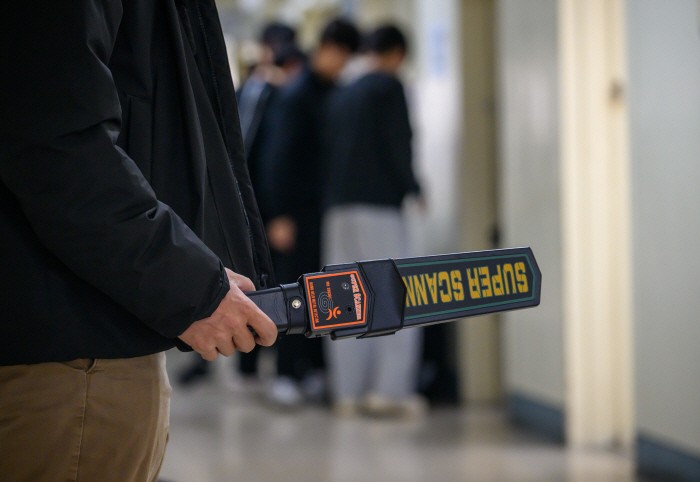 |
| An exam proctor holds a metal detector in a hallway outside a classroom at Yongsan High School in Yongsan-gu, Seoul, on November 19, when the College Scholastic Ability Test (CSAT) for the 2027 academic year was administered. / Yonhap News Agency |
The Ministry of Education has decided to secure an additional 12,000 metal detectors following concerns that schools have insufficient time to prepare for measures to prevent AI-assisted cheating in school exams. Given the difficulty of revising academic performance management regulations and school rules before the upcoming final exams, penalties for cheating will also be imposed within the scope of existing regulations for the time being.
The Ministry of Education said on November 26 that it had issued guidelines the previous day to metropolitan and provincial offices of education nationwide on school exam management to prevent cheating involving smart devices in school-based assessments.
The official notice included guidelines on school exam management, educational materials for students, checklists for each stage of exam administration and management, notices for students and parents, and instructions for hallway proctors on using an app to detect Wi-Fi signals.
Metropolitan and provincial offices of education currently have around 8,300 metal detectors. The ministry explained that the education offices plan to purchase approximately 12,000 additional metal detectors ahead of final exams for first- and second-year high school students scheduled for the first two weeks of December.
However, even after the additional purchases are completed, the total number of available metal detectors will stand at around 20,300, equivalent to just 55.4 percent of the 36,621 first- and second-year high school classes nationwide, according to last year's education statistics.
To address the shortage, metropolitan and provincial offices of education plan to borrow metal detectors from local public institutions, including police agencies, arrange equipment sharing among neighboring schools, and coordinate equipment distribution and collection at the education office level.
The stricter disciplinary standards for cheating are also unlikely to be uniformly implemented starting with the upcoming final exams. Given the seriousness of cheating involving smart devices, the ministry previously recommended imposing tougher penalties for such misconduct than for other forms of cheating.
However, considering that revising academic performance management regulations and school rules takes approximately one month, the ministry has instructed schools to deal sternly with cheating within the scope of existing regulations until the revisions are completed.
As a result, disparities in exam management, supervision and disciplinary standards depending on equipment availability and the timing of school rule revisions are likely to remain a challenge.
“The Ministry of Education will continue to work with education offices to safeguard the fairness of school-based assessments and ease the burden on schools,” the ministry said.
Park Ji-sook
Most Read
-
1
China President Xi's Keynote Speech at the APEC C..

-
2
Alice Huang, affair partner of Jensen Huang, repor..

-
3
Iran resumes attacks after two months, targeting U..

-
4
Russian warship sinks in suspected drone attack at..

-
5
Inside Kylin Villa, the symbol of China's reform h..

-
6
Trump, Xi, Putin call for security cooperation at..

-
7
Trump, Putin, Zelenskyy may hold peace talks at G2..

PEOPLE







-
Address : In-Young Bldg., 34, Uisadang-daero 1-gil, Yeongdeungpo-gu, Seoul
Copyright by ASIATODAY CO., LTD. All rights resereved