



Korea seeks to boost tea exports with focus on matcha
Nov 26, 2026, 10:55 am


 |
“We will maintain a stable tea production base and translate the growth potential of high-value-added products such as matcha into higher farm incomes and increased exports.”
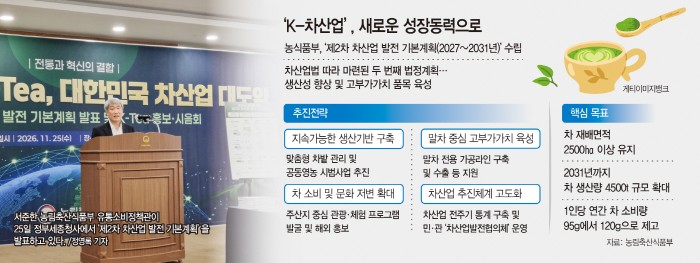
Seo Jun-han, Director General for Distribution and Consumer Policy at the Ministry of Agriculture, Food and Rural Affairs (MAFRA), made the remarks while announcing the Second Master Plan for Tea Industry Development (2027-2031) at the Government Complex Sejong on the morning of November 25.
The master plan is the second statutory plan formulated under the Act on Tea Industry Development and Tea Culture Promotion (Tea Industry Act), which was enacted and took effect in 2016. The ministry established its first 10-year master plan (2016-2026) that year and has since supported the industrial development of the tea sector through measures ranging from strengthening the production base to developing superior cultivars and fostering specialized export organizations. Following an amendment to the law last year, the planning cycle was shortened to five years.
The second master plan aims to maintain the tea cultivation area at 2,500 hectares or more and increase production to 4,500 metric tons by 2031. As of 2024, the number of domestic tea farming households stood at 2,683, down 21.2 percent from 2017, while the tea cultivation area decreased 16 percent to 2,551 hectares over the same period. Tea production also fell around 8 percent to 3,685 metric tons.
“Demand for matcha is growing both at home and abroad, but aging farmers, labor shortages, shrinking cultivation areas and insufficient processing facilities are limiting our ability to ensure a stable supply,” Seo explained. “We will shift our policy focus toward expanding the supply base for products with growth potential, such as matcha, while differentiating traditional leaf tea through quality and promoting its everyday consumption.”
Through the plan, the ministry aims to increase annual per capita tea consumption from 95 grams to 120 grams.
Under its key initiatives, the ministry will first establish a sustainable production base. It will assess tea plantation management practices and establish five management categories — regular maintenance, rehabilitation, joint management, leasing and outsourced management — to rehabilitate aging tea plantations and prevent them from falling into disuse or being abandoned.
Starting next year, the ministry will also launch a pilot project for joint tea farming worth around 3 billion won by organizing farmers around tea-purchasing companies. It will expand opportunities for young farmers to enter the tea industry by linking rental tea plantations with hands-on training and education in cultivation and traditional tea-making techniques.
The ministry will also focus on improving productivity. It will develop tea plantations on flat terrain suitable for mechanization and expand disaster prevention facilities, including irrigation systems and frost protection fans. It also plans to develop and distribute ride-on agricultural machinery for flat terrain and compact, lightweight equipment for sloping terrain to reduce labor burdens.
The annual supply of high-quality seedlings suitable for mechanical harvesting and changing climatic conditions will also increase from 40,000 to 60,000. The ministry will formulate supply plans reflecting production volumes, processing capacities and purchasing demand in each producing region to better link production with sales channels.
The ministry will also develop the matcha market into a new growth engine for the Korean tea industry. In particular, it plans to increase tea exports from $20.75 million (approximately 27.8 billion won) in 2024 to $35 million (approximately 47 billion won) by 2031. According to ministry data, the global matcha market is projected to grow around 74 percent from $5.1 billion (approximately 6.8518 trillion won) last year to $8.9 billion (approximately 11.9571 trillion won) in 2033.
“Demand for matcha is growing, particularly among younger consumers, and interest overseas is also increasing,” Seo said. “Our policy direction is to continue developing matcha, given its advantages in terms of added value.”
The ministry will seek to secure stable sales channels for farmers and a reliable supply of raw materials while expanding processing capacity. It will introduce contract farming arrangements between producers, processors and purchasing companies, with pilot operations in 2027 and 2028, followed by gradual expansion. Starting next year, it will also invest 10 billion won over two years to establish matcha processing lines at two sites in major tea-producing regions.
The ministry will also support quality and safety management and exports. It will introduce industry standards defining matcha and establishing trading specifications for different uses while strengthening safety inspections and country-of-origin management. It also plans to conduct research and development (R&D) to facilitate the adoption of standardized cultivation techniques. Exporters will receive country-specific information on labeling and customs clearance requirements, as well as assistance in obtaining international certifications, participating in overseas trade fairs and identifying potential buyers.
The ministry will promote K-Tea in cooperation with overseas diplomatic missions, Korean Cultural Centers and K-Food events. It also plans to establish and operate pilot hubs in one or two countries with strong market potential, combining hands-on experiences and promotional activities with export consultations.
In addition, the ministry will promote the everyday consumption of domestically produced tea and the integration of tea culture into daily life. It will develop tourism programs linked to major tea-producing regions such as Boseong, Hadong and Jeju to improve public accessibility.
To enhance policy implementation, the ministry also plans to compile statistics covering the entire tea industry value chain. It will convene a public-private Tea Industry Development Council twice a year to continuously monitor progress in implementing the master plan and difficulties faced by industry participants.
“We will focus our policy efforts on ensuring that K-Tea gains recognition in the global market,” Seo said.
Jeong Young-rok
Most Read
-
1
China President Xi's Keynote Speech at the APEC C..

-
2
Alice Huang, affair partner of Jensen Huang, repor..

-
3
Iran resumes attacks after two months, targeting U..

-
4
Russian warship sinks in suspected drone attack at..

-
5
Inside Kylin Villa, the symbol of China's reform h..

-
6
Trump, Xi, Putin call for security cooperation at..

-
7
Trump, Putin, Zelenskyy may hold peace talks at G2..

PEOPLE







-
Address : In-Young Bldg., 34, Uisadang-daero 1-gil, Yeongdeungpo-gu, Seoul
Copyright by ASIATODAY CO., LTD. All rights resereved