



Korean banks' bad loan ratio edges down, but credit risks persist among vulnerable borrowers
Nov 26, 2026, 10:46 am


 |
The non-performing loan (NPL) ratio of South Korean banks edged down in the third quarter of this year, but asset quality continued to deteriorate, particularly among self-employed borrowers and regional banks. In particular, the banking sector's loan loss coverage ratio has continued to decline, highlighting the need to strengthen loss-absorbing capacity in preparation for a potential increase in credit risk.
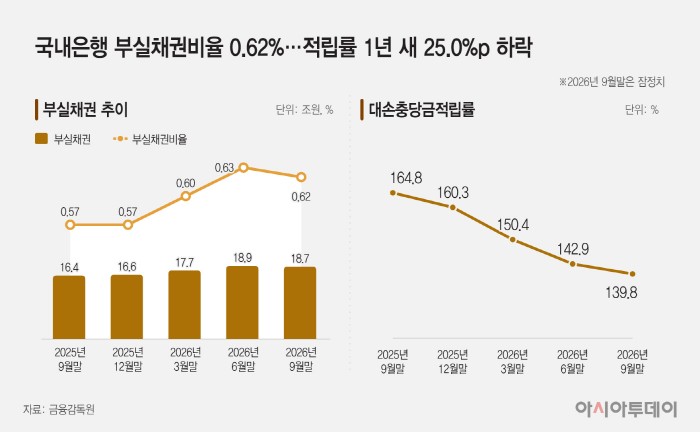
According to a report on domestic banks' non-performing loans as of the end of September released by the Financial Supervisory Service (FSS) on November 26, the NPL ratio stood at 0.62 percent, down 0.01 percentage point from 0.63 percent at the end of the previous quarter. However, it was 0.05 percentage point higher than the 0.57 percent recorded a year earlier. Outstanding NPLs totaled 18.7 trillion won, down 200 billion won from the previous quarter but up 2.3 trillion won from a year earlier.
The slight improvement in the NPL ratio was attributable to a decline in newly generated NPLs. New NPLs totaled 5.3 trillion won in the third quarter, down 1.9 trillion won from 7.2 trillion won in the previous quarter. Newly generated corporate NPLs decreased from 5.7 trillion won to 3.7 trillion won, with new NPLs among large corporations and small and medium-sized enterprises (SMEs) totaling 300 billion won and 3.5 trillion won, respectively. Newly generated household NPLs stood at 1.4 trillion won, roughly unchanged from the previous quarter.
The volume of NPL disposals also declined. Banks resolved 5.4 trillion won in NPLs in the third quarter, down 700 billion won from 6.1 trillion won in the previous quarter. Loan write-offs and sales accounted for 1.9 trillion won and 1.3 trillion won, respectively, while loan recoveries through collateral sales and loans restored to performing status amounted to 900 billion won and 800 billion won, respectively.
However, asset quality among vulnerable borrowers deteriorated. The NPL ratio for loans to individual business owners rose 0.05 percentage point to 0.72 percent, while the ratio for SME loans increased from 0.92 percent to 0.93 percent. The ratio for loans to large corporations declined from 0.53 percent to 0.50 percent. The overall corporate NPL ratio remained unchanged from the previous quarter at 0.77 percent.
Among household loans, asset quality also deteriorated, particularly in unsecured lending. Although the overall household NPL ratio remained unchanged at 0.33 percent, the ratio for other loans, including unsecured loans, increased 0.03 percentage point from 0.67 percent to 0.70 percent. The NPL ratio for mortgage loans remained unchanged at 0.22 percent.
Disparities among banks were also pronounced. In particular, the average NPL ratio of regional banks rose 0.02 percentage point from the previous quarter to 1.15 percent, nearly three times the 0.39 percent average for nationwide commercial banks. Among regional banks, Jeju Bank recorded the highest ratio at 1.48 percent, followed by Jeonbuk Bank (1.36 percent), Kwangju Bank (1.20 percent), Busan Bank (1.17 percent) and Kyongnam Bank (0.96 percent). In particular, Kwangju Bank and Jeonbuk Bank, both affiliates of JB Financial Group, recorded year-on-year increases of 0.44 percentage point and 0.43 percentage point, respectively.
Among the five major banks, NH NongHyup Bank recorded the highest NPL ratio as of the end of September at 0.53 percent, followed by Hana Bank (0.48 percent), Woori Bank (0.38 percent), KB Kookmin Bank (0.30 percent) and Shinhan Bank (0.29 percent). Compared with a year earlier, the ratios rose at NH NongHyup Bank, Hana Bank and Woori Bank but declined at KB Kookmin Bank and Shinhan Bank.
The declining level of loan loss provisions relative to NPLs is another concern. As of the end of September, domestic banks' outstanding loan loss provisions totaled 26.2 trillion won, down 700 billion won from the previous quarter. Consequently, the loan loss coverage ratio fell 3.1 percentage points from 142.9 percent to 139.8 percent, down 25.0 percentage points from 164.8 percent a year earlier. In particular, the loan loss coverage ratio of regional banks stood at 84.1 percent, down 3.8 percentage points from 87.9 percent in the previous quarter and 31.7 percentage points from 115.8 percent at the end of September last year.
The FSS assessed that although the overall NPL ratio had improved slightly due to a decline in newly generated NPLs, credit risks continued to rise in vulnerable segments, including loans to individual business owners, unsecured household loans and regional banks. In particular, the regulator stressed the need to prepare for potential further deterioration in asset quality, given economic conditions such as persistently high interest rates and rising market interest rates.
Accordingly, the FSS plans to guide banks to adequately account for the potential increase in credit risk when closing their year-end accounts and formulating business plans for next year. To this end, it will encourage banks to strengthen their loss-absorbing capacity by increasing capital and loan loss provisions, expand debt restructuring for vulnerable borrowers, and actively resolve NPLs with little prospect of recovery.
Han Sang-wook
Most Read
-
1
China President Xi's Keynote Speech at the APEC C..

-
2
Alice Huang, affair partner of Jensen Huang, repor..

-
3
Iran resumes attacks after two months, targeting U..

-
4
Russian warship sinks in suspected drone attack at..

-
5
Inside Kylin Villa, the symbol of China's reform h..

-
6
Trump, Xi, Putin call for security cooperation at..

-
7
Trump, Putin, Zelenskyy may hold peace talks at G2..

PEOPLE







-
Address : In-Young Bldg., 34, Uisadang-daero 1-gil, Yeongdeungpo-gu, Seoul
Copyright by ASIATODAY CO., LTD. All rights resereved