



U.S. proposes 15% tariff on Korean goods, leaves room for increase to 25%
Nov 26, 2026, 10:19 am


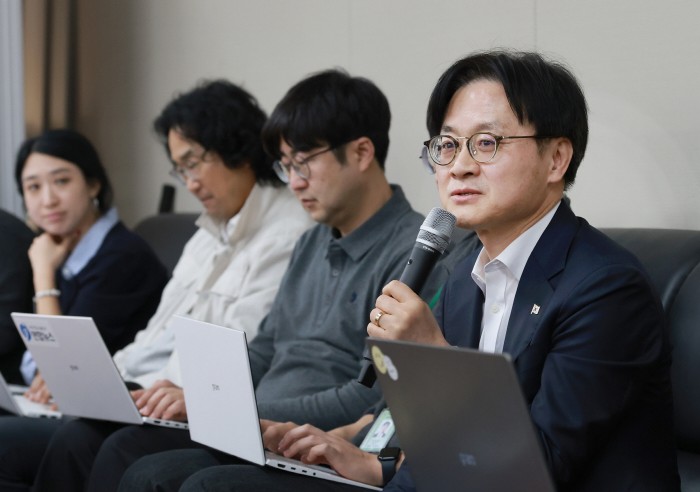 |
| Minister of Trade and Industry Kim Jung-kwan speaks with reporters covering the ministry at its press room at the Government Complex Sejong on November 25. / Ministry of Trade, Energy, and Resources |
Tensions are mounting across South Korean industries after the U.S. released the results of its Section 301 trade investigations into 16 economies, including South Korea, over excess manufacturing production. With the proposed tariff rate for South Korea set at 15 percent and the possibility of an increase to 25 percent depending on the outcome of future consultations, the government plans to continue engaging with Washington based on the implementation of the bilateral tariff agreement and focus on securing a lower final tariff rate.
The Office of the U.S. Trade Representative (USTR) on November 25 (local time) released the results of its investigations under Section 301 of the Trade Act into structural excess capacity and production in manufacturing sectors across 16 economies, including South Korea.
The USTR launched the investigations on March 11, examining the policies and practices of 16 economies, including South Korea, China and the European Union (EU).
In its newly released investigation reports, the USTR proposed baseline tariff rates for 14 of the 16 economies, excluding Norway and Mexico, taking into account existing tariff levels, the outcomes of bilateral consultations, the terms of trade agreements and trade balances.
The USTR proposed a 15 percent tariff on South Korean goods. However, it also explicitly left open the possibility of raising tariff rates to 25 percent for South Korea, 20 percent for Japan, 20 percent for the EU, 40 percent for China and 25 percent for Taiwan if the outcomes of future consultations or commitments are deemed unsatisfactory.
Regarding South Korea in particular, the USTR took issue with policies promoting production expansion across industries and sectors, preferential financing through state-owned banks, and insufficient efforts to address supply chain and excess production issues involving non-market economies.
It identified automobiles, semiconductors and petrochemicals as relevant industries, effectively interpreting South Korea's policies to promote manufacturing and its drive to expand production and exports as factors undermining the competitiveness of U.S. manufacturing.
As the tariff rates announced that day are proposed rates presented by the USTR for public comment rather than actual applicable rates, the final rates and tariff measures are expected to be determined after procedures including the submission of written comments by January 5 next year and a public hearing on January 25.
At a background briefing with reporters covering the Ministry of Trade, Industry and Resources on November 25, Minister Kim Jung-kwan said maintaining the U.S. tariff rate at 15 percent would be “more than a good outcome.”
“Given that our trade surplus with the U.S. stood at around $50 billion last year and is expected to exceed $100 billion this year, maintaining the tariff rate would be quite an achievement,” Kim said.
Regarding the Section 301 investigations, however, Kim acknowledged that they posed a major burden, adding, “We are so on edge that our hearts sink every time we receive a text message from the U.S. We are making every possible preparation.”
The Ministry of Trade, Industry and Resources held preliminary consultations with the USTR ahead of the announcement. It submitted written comments on April 15 and attended public hearings from May 5 to 8, consistently maintaining that South Korea does not exhibit structural excess capacity and production, citing, among other factors, the close integration of Korean manufacturing with U.S. supply chains.
In sharing the key details of the announcement with the South Korean government, the U.S. side reaffirmed that the announced tariff rates were proposed rather than final rates and that it would respect the outcome of the South Korea-U.S. tariff agreement in determining the final rates.
The ministry plans to closely analyze the reports and work with relevant ministries and industry representatives to actively respond to subsequent procedures, including the submission of written comments.
Kim Jeong-kyu
Most Read
-
1
China President Xi's Keynote Speech at the APEC C..

-
2
Alice Huang, affair partner of Jensen Huang, repor..

-
3
Iran resumes attacks after two months, targeting U..

-
4
Russian warship sinks in suspected drone attack at..

-
5
Inside Kylin Villa, the symbol of China's reform h..

-
6
Trump, Xi, Putin call for security cooperation at..

-
7
Trump, Putin, Zelenskyy may hold peace talks at G2..

PEOPLE






-
Address : In-Young Bldg., 34, Uisadang-daero 1-gil, Yeongdeungpo-gu, Seoul
Copyright by ASIATODAY CO., LTD. All rights resereved